<?xml version="1.0" encoding="UTF-8"?>
<?xml-stylesheet type="text/xsl" href="/wp-content/themes/feed/atom.xsl"?>
<feed
        xmlns="http://www.w3.org/2005/Atom"
        xmlns:wwe="http://release.wwe.com/atom/1.0"
        xmlns:thr="http://purl.org/syndication/thread/1.0"
        xmlns:taxo="http://purl.org/rss/1.0/modules/taxonomy/"
        xml:lang="en-US"
        xml:base="https://www.mlg.us.com/wp-atom.php"
	>
    <title type="text">Macaluso LLP</title>
    <subtitle type="text">Macaluso LLP</subtitle>

    <updated>2025-09-19T06:47:22Z</updated>

    <link rel="alternate" type="text/html" href="https://www.mlg.us.com" />
    <id>https://www.mlg.us.com/feed/atom/</id>
    <link rel="self" type="application/atom+xml" href="https://www.mlg.us.com/feed/atom/?forceByPassCache=0.8673548525297454" />
	
	<generator uri="https://wordpress.org/" version="6.9.4">WordPress</generator>
<icon>/wp-content/uploads/sites/1604731/2022/11/cropped-macaluso-siteicondark-512c-32x32.jpg</icon>
        <entry>
            <author>
									                    <name>On Behalf of Macaluso LLP</name>
				            </author>
            <title type="html"><![CDATA[The Great LATAM Arbitrage: How Geography Became Strategy]]></title>
            <link rel="alternate" type="text/html" href="https://www.mlg.us.com/blog/2025/07/the-great-latam-arbitrage-how-geography-became-strategy/" />
            <id>https://www.mlg.us.com/?p=257950</id>
            <updated>2025-07-30T11:43:22Z</updated>
            <published>2025-07-30T11:04:57Z</published>
					<taxo:topics><![CDATA[-]]></taxo:topics>
            <summary type="html"><![CDATA[Brilliant founders are discovering that their postal code determines their valuation more than their product In 2024, Latin American startups attracted around $4.2 billion in venture capital, and the region now boasts around thirty unicorns compared to just nine in 2019. Yet beneath these impressive headlines lies a more fascinating story: the importance of geographic arbitrage in the global startup…]]></summary>
			                <content type="html" xml:base="https://www.mlg.us.com/blog/2025/07/the-great-latam-arbitrage-how-geography-became-strategy/"><![CDATA[<h2>Brilliant founders are discovering that their postal code determines their valuation more than their product</h2>
In 2024, Latin American startups attracted around <a href="https://news.crunchbase.com/venture/latin-america-startup-funding-eoy-2024/#:~:text=Latin%20America%20startup%20investment%20closed,increase%20from%20the%20prior%20year." target="_blank" rel="noopener noreferrer" data-wpel-link="external">$4.2 billion in venture capital</a>, and the region now boasts around <a href="https://www.failory.com/startups/latin-american-unicorns" target="_blank" rel="noopener noreferrer" data-wpel-link="external">thirty unicorns</a> compared to just <a href="https://impact.economist.com/new-globalisation/beyond-unicorns-smaller-companies-also-hold-great-promise-latin-america" target="_blank" rel="noopener noreferrer" data-wpel-link="external">nine in 2019</a>. Yet beneath these impressive headlines lies a more fascinating story: the importance of geographic arbitrage in the global startup ecosystem.
<h3>Valuation Disparities</h3>
Consider this statistical anomaly: LATAM startups with similar product-market fit, revenue profiles, and growth trajectories consistently trade at lower revenue multiples in their home markets as <a href="https://magmapartners.com/post/most-latin-american-saas-startups-are-not-built-to-generate-venture-capital-returns#:~:text=Historically%2C%20Latin%20American%20SaaS%20multiples,businesses%2C%20but%20it%27s%20extremely%20hard." target="_blank" rel="noopener noreferrer" data-wpel-link="external">compared to U.S. companies</a>. This isn’t market inefficiency—it’s systematic mispricing that has created a valuation gap of billions across the region’s top growth-stage companies.

The structural challenges run deeper than simple valuation gaps. Early-stage funding in LATAM remains limited, highly concentrated, and burdened by regional risk premiums that depress valuations regardless of company quality. Many promising startups struggle to raise meaningful capital, access sophisticated financial infrastructure, or position themselves for high value exits. These companies often remain heavily exposed to regional volatility, creating additional friction that compounds their disadvantages.

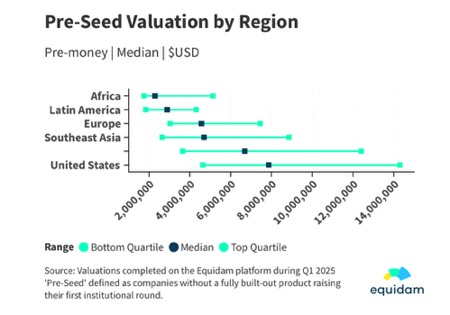
The numbers tell the story of structural disparity. While LATAM’s venture capital ecosystem manages $12.4 billion in dry powder, the U.S. market sits on $580 billion—a 47x difference that translates directly into founder outcomes. Regarding <a href="https://news.crunchbase.com/venture/european-venture-us-comparison-investment-round-size/?utm_source=chatgpt.com" data-wpel-link="external" target="_blank" rel="noopener noreferrer">valuations</a>, U.S. startups at the <a href="https://www.equidam.com/startup-valuation-delta-q1-2025/" data-wpel-link="external" target="_blank" rel="noopener noreferrer">seed</a> and Series B stages raise larger rounds and command higher valuations than any other region globally.
<img src="/wp-content/uploads/sites/1604731/2025/07/Pre-seed_valuation_by_Region.png" alt="" width="300" height="210" class="alignnone size-medium wp-image-257956" id="fl-blog-img" />
<h3>Strategic Migration</h3>
What’s emerging isn’t brain drain, but something far more sophisticated: geographic arbitrage optimization. An increasing percentage of LATAM unicorns and start-ups now maintain significant U.S. operations, not as an escape from their home markets but as a multiplier for their regional advantages.

A gateway not just to capital, but to a model where they can buy global scale at regional efficiency prices. It's a strategic code these entrepreneurs have cracked.

Take Nowports, the Monterrey-based logistics platform founded in 2018. When CEO Alfonso de los Ríos opened a Miami office in 2023, he wasn’t just establishing a logistical foothold in a major US port—he was repositioning his entire company for capital access and building the foundation to facilitate a robust vertical integration model offering insurance and financing. The result was a $240 million funding round across Series A, B, and C rounds led by SoftBank, Tiger Global, Foundation Capital, and others, at 4.2x valuations. As de los Ríos observed, "Miami didn’t just give us port access—it gave us investor access."

This pattern repeats across sectors. Mexican fintech Broxel, founded in 2011 as an app for streamlining multiple currency accounts for remittances, discovered that establishing offices in Texas and California—strategic locations in the remittance industry—opened new customer segments. When the company launched its Miami Dolphins-branded prepaid card through a Miami office alliance, it wasn’t just a marketing gimmick but a strategic embedding that elevated its brand across North America.
<h3>Four Pillars of Arbitrage</h3>
The migration northward is based on four strategic foundations that collectively create an irresistible pull for ambitious founders in LATAM.
<ul>
 	<li><strong>Capital density</strong> remains the primary driver. Despite LATAM’s maturing venture ecosystem, <a href="https://www.institutionalinvestor.com/article/2dx6hsx6ifqynskb7oav4/corner-office/most-of-the-worlds-assets-continue-to-flow-to-north-america#:~:text=In%202023%2C%2055.5%20percent%20of,grew%20substantially%20by%2015.2%20percent." data-wpel-link="external" target="_blank" rel="noopener noreferrer">55.5%</a> of global venture capital assets under management remain U.S.-based. The depth, scale, and diversity of the U.S. investment landscape simply cannot be replicated in regional markets. While venture capital activity in Latin America has grown significantly over the past decade, early-stage funding remains limited and highly concentrated, often requiring companies to accept lower valuations due to perceived regional risk.
Institutional investors still allocate domestically first, creating a natural ceiling for LATAM-only startups that U.S. presence immediately lifts. <a href="https://news.crunchbase.com/venture/latin-america-funding-penacastro-leadsales/" data-wpel-link="external" target="_blank" rel="noopener noreferrer">The U.S. offers access to vast networks</a> of capital firms, corporate investors, and growth equity funds that actively seek exposure to high-growth sectors, such as fintech, logistics, and healthcare, precisely <a href="https://www.realinstitutoelcano.org/en/analyses/latin-americas-flourishing-tech-enterprise-ecosystem-and-startups-current-situation-and-challenges/" data-wpel-link="external" target="_blank" rel="noopener noreferrer">where LATAM startups have been thriving</a>.</li>
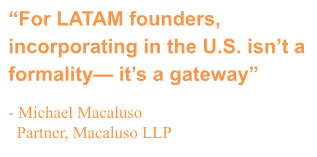
 	<li><strong>Market unification</strong> offers a second compelling advantage. While LATAM encompasses 660 million people across 33 countries with distinct currencies and regulatory frameworks—markets that remain fragmented by language, regulations, and economic volatility—the U.S. presents 330 million consumers operating within a single currency, regulatory system, and logistics infrastructure. More crucially, the average <a href="https://www.demandsage.com/average-us-income/#:~:text=The%20average%20annual%20salary%20and,a%204.38%25%20increase%20from%202023." target="_blank" rel="noopener noreferrer" data-wpel-link="external">U.S. household income is $61, 984 USD</a>. Compare that to Costa Rica, the country leading in average income in LATAM, with an average income of <a href="https://latamfdi.com/average-salary-in-latin-america/" target="_blank" rel="noopener noreferrer" data-wpel-link="external">$1,045 USD</a>, creating premium customer segments that justify higher unit economics.
<img src="/wp-content/uploads/sites/1604731/2025/07/LATAM.png" alt="" width="300" height="149" class="alignnone size-medium wp-image-257955" id="fl-blog-img" />
The U.S. market offers unmatched scale, purchasing power, and infrastructure, enabling companies to test new products, capture premium customers, and establish brand recognition in a globally visible space. Success in the U.S. validates business models and increases attractiveness to future investors in ways that fragmented regional success cannot match.</li>
 	<li><strong>Financial infrastructure</strong> provides the operational backbone that fragmented LATAM systems often cannot. While Latin America’s financial systems have improved in recent years, challenges such as regulatory restrictions, currency volatility, and limited venture debt markets create significant barriers for startups seeking to scale rapidly or manage cross-border operations.
The U.S. banking ecosystem offers several critical advantages: stable financial services, access to venture debt and growing financing products not widely available in LATAM, advanced digital payment processing services, and easier integration with global financial markets. For startups managing international customer bases, U.S. operations simplify the collection of U.S. dollar revenues, payments to suppliers, and the establishment of partnerships with major financial institutions.
<img src="/wp-content/uploads/sites/1604731/2025/07/cross-border.png" alt="" width="300" height="189" class="alignnone size-medium wp-image-257954" id="fl-blog-img"/>
That fluency often takes shape through financial infrastructure, where U.S.-based systems become not just a convenience but a competitive advantage.
Meanwhile, Uruguayan API company <a href="https://prometeoapi.com/en" data-wpel-link="external" target="_blank" rel="noopener noreferrer">Prometeo</a>, founded in 2018, exemplifies this infrastructure advantage. The company entered the U.S. market in June 2024 with a Bank Account Validation API connecting Latin American businesses to 100% of U.S. banks via a single integration. By March 2025, Prometeo had expanded to a full "Borderless Banking" suite, enabling companies to open accounts for collections, automate payments, and track fund movement across U.S. and Latin American banking systems. This U.S. integration became a product advantage rather than merely an operational necessity, enabling clients to conduct secure, compliant financial operations essential for scaling cross-border services while attracting top-tier investors.</li>
 	<li><strong>Exit optimization</strong> closes the loop on value creation. There have been <a href="https://cuanticovc.com/latin-america-venture-capital-report-2025/" target="_blank" rel="noopener noreferrer" data-wpel-link="external">79</a> venture capital-backed startup exits in Latin America since 2017, however the number has been declining since 2021 suggesting that a significant portion of exits may have involved U.S. acquirers or IPOs.<img src="/wp-content/uploads/sites/1604731/2025/07/Todd-Vollmers.png" alt="" width="300" height="146" class="alignnone size-medium wp-image-257953" id="fl-blog-img-last"/></li>Cornershop’s $3 billion acquisition by Uber exemplified this dynamic—the Chilean-Mexican company’s early U.S. establishment made it an ideal integration target, enabling an exit that might have been capped at a fraction of the exit amount without American operational presence.
</ul>
<h3>Cost of Migration</h3>
This arbitrage opportunity comes at a cost. Execution complexity multiplies as companies navigate dual compliance regimes, cultural gaps, and visa constraints for key talent. <a href="https://boomit.us/en/fintech-latam-customer-acquisition-costs/" target="_blank" rel="noopener noreferrer" data-wpel-link="external">Customer acquisition costs can rise significantly</a> as companies recalibrate their messaging and distribution for new markets. Operational overhead can increase by hundreds of thousands of dollars annually due to the costs of managing legal, tax, and compliance requirements across multiple jurisdictions. A <a href="https://boomit.us/en/fintech-latam-customer-acquisition-costs/" target="_blank" rel="noopener noreferrer" data-wpel-link="external">study</a> done on 68 fintech companies in LATAM found that costs tend to increase by 10% when expanding into markets like Mexico, Uruguay, Colombia, and Chile.

Perhaps most significantly, the strategy requires founders to maintain a delicate balance between global ambition and regional roots. The most successful practitioners aren’t abandoning LATAM but leveraging it, keeping R&amp;D, engineering, and core operations in cost-efficient home markets while establishing strategic footholds in higher-value ecosystems.
<h3>Opportunistic Geographic Arbitrage</h3>
The Latin American startup ecosystem has become one of the world’s most dynamic markets, capturing increasing attention from U.S. investors, venture funds, and strategic buyers. Yet, while LATAM offers exceptional energy, talent, and market opportunity, the structural constraints remain real. Limited capital pools, fragmented consumer markets, and constrained exit routes all pose challenges for startups operating solely within regional boundaries. To mitigate against these constraints, establishing operations or legal entities in the United States provides access to advantages that are difficult to replicate in Latin America.

This isn’t about abandoning LATAM markets—it’s about building the financial and operational foundation necessary to compete and thrive on a global stage. In an era where digital infrastructure has theoretically flattened global competition, these entrepreneurs are demonstrating that physical presence and strategic positioning still generate significant value. And what’s unfolding across Latin America represents the emergence of a model for global startup development that challenges Silicon Valley’s monopoly on innovation scaling. These founders are proving that world-class companies can be built anywhere but optimized everywhere, recognizing that geography is not a destiny, but a strategic advantage.

For investors, this creates opportunity: backing top-tier talent at regional prices with global upside potential.

<strong>Macaluso LLP LATAM Team:</strong>

Michael Macaluso
<a href="mailto:mmacaluso@macalusollp.com">mmacaluso@macalusollp.com</a>

Peter Cejas
<a href="mailto:pcejas@macalusollp.com">pcejas@macalusollp.com</a>

Todd Vollmers
<a href="mailto:tvollmers@macalusollp.com">tvollmers@macalusollp.com</a>

Jack Cahill (tax)
<a href="mailto:jcahill@macalusollp.com">jcahill@macalusollp.com</a>

Tom Kennedy (regulatory)
<a href="mailto:tkennedy@macalusollp.com">tkennedy@macalusollp.com</a>]]></content>
						        </entry>
	        <entry>
            <author>
									                    <name>On Behalf of Macaluso LLP</name>
				            </author>
            <title type="html"><![CDATA[Structural Traps That Can Derail LATAM Companies Entering the U.S. Market]]></title>
            <link rel="alternate" type="text/html" href="https://www.mlg.us.com/blog/2025/06/structural-traps-that-can-derail-latam-companies-entering-the-u-s-market/" />
            <id>https://www.mlg.us.com/?p=257944</id>
            <updated>2025-07-01T04:34:56Z</updated>
            <published>2025-07-01T04:03:29Z</published>
					<taxo:topics><![CDATA[LATAM]]></taxo:topics>
            <summary type="html"><![CDATA[A U.S. Entity on Paper Isn’t a Business—Without Control, It’s a Liability For Latin American startups and growth-stage companies, the U.S. market remains the ultimate proving ground—a deep capital pool, massive customer base, and the credibility that comes with success in the world’s most competitive economy. Yet despite achieving strong traction in their home markets, many high-potential LATAM companies falter…]]></summary>
			                <content type="html" xml:base="https://www.mlg.us.com/blog/2025/06/structural-traps-that-can-derail-latam-companies-entering-the-u-s-market/"><![CDATA[<strong>A U.S. Entity on Paper Isn’t a Business—Without Control, It’s a Liability</strong>

For Latin American startups and growth-stage companies, the U.S. market remains the ultimate proving ground—a deep capital pool, massive customer base, and the credibility that comes with success in the world’s most competitive economy. Yet despite achieving strong traction in their home markets, many high-potential LATAM companies falter when entering the U.S. Not due to flawed products or weak teams—but because of entirely avoidable structural and legal missteps.

U.S. investors approach international opportunities with institutional expectations shaped by thousands of domestic deals. They look for clean corporate structures, centralized ownership of IP and key assets, scalable operations, and rigorous governance. When those elements are missing or improvised, even the most promising ventures become difficult to fund—or worse, secure early investment only to unravel during later-stage diligence, restructuring, or exits.

This is the first in a series from Macaluso LLP aimed at helping LATAM founders and owners navigate the legal and structural realities of U.S. expansion.

<strong>The Shell Company Trap — Misaligned Entity Architecture</strong>

Too often, LATAM companies incorporate a Delaware C-Corp to signal readiness for U.S. capital—but fail to migrate their actual business. The result is a hollow structure: a U.S. entity that exists only on paper while the team, customer contracts, and intellectual property remain offshore. Investors recognize this as a “shell” structure—one they will not underwrite.

To establish a fundable U.S. presence, founders must execute a proper “flip” transaction that transfers ownership of IP and core contracts into the U.S. entity, formalizes intercompany agreements for services or licensing, and builds operational substance through local hiring and payroll. Leveraging bilateral tax treaties can reduce exposure during this process. A strategic flip not only improves fundability but reduces jurisdictional risk for future acquirers and investors.

<strong>IP Fragmentation — The Hidden Time Bomb</strong>

Ownership of intellectual property is one of the most overlooked—and consequential—issues facing LATAM companies. Code developed by contractors, unclear agreements with co-founders, or IP held in offshore affiliates often results in incomplete or contested title. Investors take IP chain-of-title very seriously, and any ambiguity can halt a deal or dramatically reduce valuation.

To avoid this, companies must retroactively secure written IP assignments from all contributors, maintain documentation of creation histories, and ensure key assets are properly registered in the U.S. Jurisdictions with weak or delayed protections are not substitutes. U.S. registration demonstrates seriousness and safeguards future enforcement. It’s also critical to build assignment clauses directly into hiring and vendor agreements from the outset.

<strong>Tax Exposure — The Compliance Iceberg</strong>

Cross-border activity often triggers U.S. tax obligations earlier than founders expect. Whether through remote work arrangements, sales to U.S.-based customers, use of cloud infrastructure, or intercompany invoicing, “nexus” can arise invisibly—and with it, liabilities.

Undisclosed tax exposure not only creates financial risk but signals to investors a lack of regulatory sophistication. Founders should proactively conduct nexus studies, evaluate transfer pricing strategies, and register for state and federal tax compliance where required. These steps should be part of early-stage planning, not a scramble during due diligence.

<strong>Employment and Immigration Pitfalls</strong>

Growth-stage companies looking to scale U.S. operations often misclassify workers or use informal cross-border payment structures that violate labor and tax law. Paying U.S.-based talent through offshore entities, or treating full-time staff as independent contractors, may seem flexible but exposes the company to legal risk.

To scale with credibility, companies must implement compliant U.S. payroll and benefits, properly classify workers under U.S. standards, and plan for visa strategies for founders and critical hires. For early operations, using a Professional Employer Organization (PEO) may provide a compliant bridge while building internal HR capacity.

<strong>Regulatory Blind Spots</strong>

In regulated verticals like fintech and healthtech, failing to address licensing, AML policies, or state-specific registration requirements can be a deal-breaker. These aren’t just technicalities—they’re prerequisites for market entry and funding.

Companies should identify relevant federal and state requirements early and retain specialized legal counsel to develop internal compliance systems. Using pilot programs or sandbox environments can provide a regulatory bridge, but they are not a substitute for full compliance planning.

<strong>Weak Governance — The Institutional Maturity Test</strong>

LATAM businesses frequently operate on trust-based founder dynamics: decisions made over messaging apps, cap tables tracked informally, and minimal board involvement. But informal governance becomes a liability when institutional capital enters the picture.

Investors expect board structures with real oversight, documented authorizations, internal controls over major expenditures, and reliable financial reporting. Establishing independent board seats where appropriate, implementing audit-readiness protocols, and generating regular KPI dashboards are all markers of a scale-ready company.

<strong>The Path Forward</strong>

Succeeding in the U.S. is about more than having a great product or loyal customers. It demands structural clarity, legal foresight, and operational maturity. The companies that raise capital, grow sustainably, and ultimately exit successfully are those that build these foundations early.

A well-structured U.S. presence not only improves funding prospects—it limits downside risk, enhances credibility, and creates the optionality that today’s cross-border investors require. In short, it proves that your business can operate at institutional standards.

<hr>

<strong>Need Help Crossing the Border?</strong>

<strong>Macaluso LLP</strong> is a boutique corporate law firm with deep experience guiding LATAM companies through U.S. expansion. From entity flips and IP consolidation to tax structuring and regulatory compliance, we offer sophisticated counsel tailored to the realities of international growth.

Our team has advised on billions of dollars in cross-border deals, bringing large-firm quality with founder-friendly access. With offices in New York, Florida, and Minnesota, we combine strategic insight with legal execution that works at growth speed.

<a href="http://www.macalusollp.com" data-wpel-link="external" target="_blank" rel="noopener noreferrer">www.macalusollp.com</a>]]></content>
						        </entry>
	        <entry>
            <author>
									                    <name>On Behalf of Macaluso LLP</name>
				            </author>
            <title type="html"><![CDATA[SEC Rules Overturned – What Does This Mean For The Private Fund Business Going Forward?]]></title>
            <link rel="alternate" type="text/html" href="https://www.mlg.us.com/blog/2024/12/sec-rules-overturned-what-does-this-mean-for-the-private-fund-business-going-forward/" />
            <id>https://www.mlg.us.com/?p=257910</id>
            <updated>2024-12-17T06:21:54Z</updated>
            <published>2024-12-17T06:11:03Z</published>
					<taxo:topics><![CDATA[-]]></taxo:topics>
            <summary type="html"><![CDATA[In a significant legal development, several recent court rulings have struck down key regulations imposed by the U.S. Securities and Exchange Commission (SEC) on private funds, deeming them unconstitutional. In another case, the SEC’s practice of using in-house panels to decide enforcement cases was found to be unconstitutional. These decisions have profound implications for the financial industry, particularly for private…]]></summary>
			                <content type="html" xml:base="https://www.mlg.us.com/blog/2024/12/sec-rules-overturned-what-does-this-mean-for-the-private-fund-business-going-forward/"><![CDATA[In a significant legal development, several recent court rulings have struck down key regulations imposed by the U.S. Securities and Exchange Commission (SEC) on private funds, deeming them unconstitutional. In another case, the SEC’s practice of using in-house panels to decide enforcement cases was found to be unconstitutional. These decisions have profound implications for the financial industry, particularly for private equity, hedge funds, and other private investment vehicles.

<a href="/wp-content/uploads/sites/1604731/2024/12/SEC-RULES-OVERTURNED.pdf" target="_blank" rel="noopener" data-wpel-link="internal">Read More.</a>]]></content>
						        </entry>
	        <entry>
            <author>
									                    <name>On Behalf of Macaluso LLP</name>
				            </author>
            <title type="html"><![CDATA[The Corporate Transparency Act Was Found Unconstitutional]]></title>
            <link rel="alternate" type="text/html" href="https://www.mlg.us.com/blog/2024/12/the-corporate-transparency-act-was-found-unconstitutional/" />
            <id>https://www.mlg.us.com/?p=257907</id>
            <updated>2024-12-18T12:02:13Z</updated>
            <published>2024-12-06T15:03:38Z</published>
					<taxo:topics><![CDATA[-]]></taxo:topics>
            <summary type="html"><![CDATA[The Corporate Transparency Act (the “CTA”)[1] was found to be unconstitutional by the US. District Court for the Eastern District of Texas. In Texas Top Cop Shop v Garland et al. (case 4:24-cv-00478 December 3, 2024), the U.S. District Court for the Eastern District of Texas issued a nationwide preliminary injunction against the enforcement of the Corporate Transparency Act (CTA)…]]></summary>
			                <content type="html" xml:base="https://www.mlg.us.com/blog/2024/12/the-corporate-transparency-act-was-found-unconstitutional/"><![CDATA[<div>The Corporate Transparency Act (the “CTA”)[1] was found to be unconstitutional by the US. District Court for the Eastern District of Texas. In Texas Top Cop Shop v Garland et al. (case 4:24-cv-00478 December 3, 2024), the U.S. District Court for the Eastern District of Texas issued a nationwide preliminary injunction against the enforcement of the Corporate Transparency Act (CTA) and the related Reporting Rule issued by the U.S. Department of the Treasury’s Financial Crimes Enforcement Network (FinCEN). The Court questioned the CTA’s constitutionality and its impact on small businesses. The CTA, enacted as part of broader anti-money laundering efforts, mandates companies to disclose their beneficial ownership information to a federal database maintained. In granting the plaintiff’s motion for summary judgment, the major deadline set by FinCEN for entities that would have been required to file beneficial ownership reporting at year-end, is now no longer applicable, at least for the time being.</div>
<h2>What should firms be doing now?</h2>
<div>If you have not already filed the reports required by the Reporting Rule, you no longer need to be concerned with the deadline. We think, however, that it is usually prudent to organize and update your documentation regarding your legal entities, and their beneficial owners, for a number of reasons, including that this ruling could later reversed. It remains to be seen whether the government will appeal, or whether other litigants will seek to challenge the Reporting Rule and CTA. It also remains to be seen whether the Reporting Rule or any other variation of it would continue to have the support of FinCEN after the inauguration of Donald Trump. In theory, his administration, once in place at FinCEN, could take a different approach, and a Republican controlled Congress may or may not act to change the CTA to better meet constitutional standards, if that is ultimately possible. Until then, compliance with the Reporting Rule is not required. Please <a href="/contact/" data-wpel-link="internal">contact</a> Macaluso LLP if you have any questions.</div>]]></content>
						        </entry>
	        <entry>
            <author>
									                    <name>On Behalf of Macaluso LLP</name>
				            </author>
            <title type="html"><![CDATA[Deadline Approaches For Corporate Transparency Act]]></title>
            <link rel="alternate" type="text/html" href="https://www.mlg.us.com/blog/2024/12/deadline-approaches-for-corporate-transparency-act/" />
            <id>https://www.mlg.us.com/?p=257904</id>
            <updated>2024-12-17T06:17:28Z</updated>
            <published>2024-12-04T15:21:07Z</published>
					<taxo:topics><![CDATA[-]]></taxo:topics>
            <summary type="html"><![CDATA[A major deadline set by The U.S. Department of the Treasury’s Financial Crimes Enforcement Network (“FinCEN”) for entities that are required to file beneficial ownership reporting under the Corporate Transparency Act (the “CTA”), is quickly approaching on January 1, 2025. While FinCEN’s rule setting out the reporting requirements with respect to “Reporting Companies,” including the information required to be reported…]]></summary>
			                <content type="html" xml:base="https://www.mlg.us.com/blog/2024/12/deadline-approaches-for-corporate-transparency-act/"><![CDATA[<img style="width: 100%;" src="/wp-content/uploads/sites/1604731/2024/12/Picture1.jpg" alt="decorative image" />

A major deadline set by The U.S. Department of the Treasury’s Financial Crimes Enforcement Network (“FinCEN”) for entities that are required to file beneficial ownership reporting under the Corporate Transparency Act (the “CTA”), is quickly approaching on January 1, 2025. While FinCEN’s rule setting out the reporting requirements with respect to “Reporting Companies,” including the information required to be reported to FinCEN and the due dates (the “Reporting Rule”), went into effect at the beginning of 2024 for newly formed companies, the bulk of reports have not been required to be filed until now. Companies that have not considered their filing requirements under the CTA and Reporting Rule should therefore act now.
<h2><strong>Who is required to file under the Reporting Rule?</strong></h2>
Under the Reporting Rule, Reporting Companies include (1) any corporation, limited liability company, or entity created by the filing of a document with an secretary of state in any state of the United States or any Indian tribe or similar office and (2) any corporation, limited liability company or other entity formed under the law of a foreign country that is registered to do business in any U.S. state or tribal jurisdiction by the filing of a document with the secretary of state or any similar office under the law of a U.S. state or Indian tribe.
<h2><strong>When are the initial filings due? </strong></h2>
Specifically, the deadlines for Reporting Companies to file their initial beneficial ownership reports are:
<ul>
 	<li>Reporting Companies formed (or who became Reporting Companies, such as in the case of a foreign entity that files to do business in the U.S.) before January 1, 2024, must file by January 1, 2025.</li>
 	<li>Reporting Companies formed (or who became Reporting Companies) on or after January 1, 2024, but before January 1, 2025, have been required to file within 90 days of such formation.</li>
 	<li>Reporting Companies formed (or who become Reporting Companies) on or after January 1, 2025, must file their initial beneficial ownership reports within 30 days of such formation.</li>
</ul>
<h2><strong>What information is required to be filed? </strong></h2>
The report requires the Reporting Company to provide identifying information, such as the Reporting Company’s name (and any DBAs), address and where the entity is registered, as well as a taxpayer identification number (“TIN”) issued by the IRS. All Reporting Companies will be required to file for and receive a TIN number from the IRS before they can file a beneficial owner report.

Each Reporting Company is required to identify and report its Company Applicant (s) as well as its Beneficial Owners, as discussed below.

The Reporting Rule identifies two types of Company Applicants. The first type is that existing Reporting Companies must identify the natural person that formed a domestic Reporting Company or that registered a foreign Reporting Company, as applicable (the “Direct Filer”) as a Company Applicant. The second category of Company Applicant is only applicable to a new Reporting Company when a natural person other than the Direct Filer is primarily responsible for directing or controlling the formation or registration, as applicable, of the new Reporting Company. All Company Applicants must be natural persons.

A “Beneficial Owner” is any natural person who either, directly, or indirectly, exercises substantial control over a Reporting Company or who owns or controls at least 25 percent of the ownership interests of a Reporting Company. Those exercising “substantial control” of a Reporting Company include those who serve as senior officers of the Reporting Company, or who have the authority to appoint or remove senior officers or a majority of the board of directors (or similar body) of a Reporting Company, as well as any who directs, determines, or has substantial influence over decisions of the Reporting Company.

There may be more than one Company Applicant (although there is typically only one) and there is often more than one Beneficial Owner.

Reporting Companies will need to include each Beneficial Owner’s and Company Applicant’s name, date of birth, residential address (for Beneficial Owners) or in the case of a Company Applicant that forms or registers any New Reporting Company as a part of a business of doing so, their business address. They also must include an identifying number for the Beneficial Owner or Company Applicant from an official document such as a passport or U.S. driver’s license and the name of the issuing State or jurisdiction, as well as upload an image of that identification.
<h2><strong>Are there any exemptions to the Reporting Rule?</strong></h2>
In addition to filing an initial beneficial owner report, Reporting Companies must also update and correct information in their previously filed reports within specified time limits on a going forward basis. Aside from the initial filing requirement, because there is a responsibility to prepare and file ongoing updates to the reports, all companies should consider with their counsel or advisers whether one or more of the exemptions apply. FinCEN provided extensive guidance on these exemptions and published it in multiple languages.

The Reporting Rule provides twenty-three types of entities that are exempt from beneficial ownership information reporting requirements, including publicly traded companies, banks, registered broker dealers, nonprofits, and entities formed or operated as part of a government structure (such as Indian tribes or States and municipalities). In many cases, subsidiaries of these entities may also be exempt. Among the twenty-three exemptions from the Reporting Rule, some are likely to be commonly applicable. Additional exempt entities include those who are registered pursuant to the Commodity Exchange Act, large operating companies with significant revenues and employees, tax-exempt entities, and subsidiaries of certain exempt entities. The gist of the exemptions is to provide relief to entities that already provide beneficial ownership information to the government.
<h2><strong>Investment Adviser Exemptions</strong></h2>
One such example, investment advisers registered with the SEC and their affiliated general partners, and private funds (which are funds relying on exemptions from the requirement to register as an investment company pursuant to Section 3(c)(1) or 3(c)(7)<a name="_ftnref1"></a> under the Investment Company Act), that are managed by investment advisers who are registered with the SEC, and that are identified by name on the adviser’s Form ADV, are exempt from the requirement to file. Subsidiaries of exempt pooled investment vehicles are not automatically exempt from the Reporting Rule and must be examined individually to see if another exemption is available for them.

Another is for venture capital fund advisers (advisers relying on the venture capital adviser exemption under the Investment Advisers Act and filing as an Exempt Reporting Adviser (ERA)). Still another is for registered investment companies (whether they are open or closed end, or an ETF). It should be noted that investment advisers that are not registered with the SEC (or that are exempt reporting advisers, other than venture capital fund advisers) and the funds they advise, are not expressly exempt from the definition of Reporting Company.
<h2><strong>What happens if a Reporting Company fails to report?</strong></h2>
It remains to be seen what level of enforcement activity that FinCEN will engage in, but the CTA does provide for penalties for con-compliance. Any willful failure to report complete or updated beneficial ownership information to FinCEN, or the willful provision of or attempt to provide false or fraudulent beneficial ownership information may result in civil penalties of up to $500 for each day that the violation continues, or criminal penalties including imprisonment for up to two years and/or a fine of up to $10,000. Senior officers of an entity that fails to file a required BOI report may be held accountable for that failure.
<h2><strong>Is the CTA here to stay? </strong></h2>
On March 1, 2024, a federal district court in the Northern District of Alabama ruled that the CTA exceeds the Constitution’s limits on Congress’s power and enjoined FinCEN from enforcing the CTA against the plaintiffs, who were a small business industry group. [FN 1] The government has appealed. Other than the individuals and entities that enjoy the court’s enforcement injunction against FinCEN, all other Reporting Companies are still required to comply with the law and file beneficial ownership reports as provided in the Reporting Rule. It remains to be seen whether the government will succeed in that appeal, or whether other litigants will seek to challenge the Reporting Rule and CTA. It also remains to be seen whether the Reporting Rule will remain in effect after the inauguration of Donald Trump. In theory, his administration, once in place at FinCEN, could revise the Reporting Rule, or take a hands-off approach on enforcement, or a Republican controlled Congress could act to repeal or change the CTA. Until then, compliance with the Reporting Rule is the law and Reporting Companies must continue to comply.
<h2><strong>Conclusion</strong></h2>
Understanding how the Reporting Rule will apply to a particular company, and what information about what people associated with them will need to be included, will require analysis. If you haven’t already, Macaluso LLP is ready to assist you in determining whether your entities are Reporting Companies and, if so, what information about its Company Applicants and Beneficial Owners will be required to be included in the filing. If you require such advice or would like assistance with filing, please reach out to your Macaluso LLP contact.

<hr />

<ol>
 	<li><span style="font-size: 10pt;"> <em>National Small Business United v. Yellen</em>, No. 5:22-cv-01448 (N.D. Ala.)</span></li>
</ol>
<span style="font-size: 10pt;">Written by: Thomas G. Kennedy, Esq.</span>

<span style="font-size: 10pt;">A Partner in Macaluso, LLP’s Investment Management Regulation and Compliance Practice, Tom serves as counselor to asset management firms and institutional investors as well as service providers on regulatory and compliance legal matters including preparations for upcoming SEC rules, review and drafting of investment advisory and other contracts, disclosures, consents and no-action letter requests for various transactions, and advice concerning management and prevention of enforcement liability. </span>

<span style="font-size: 10pt;">Tom also serves as a Managing Director, and Head of Institutional Asset Management for AltPilot Group, which offers asset management firms and institutional investors, as well as service providers consulting on compliance risk management from designing and implementing compliance programs, to managing a wide range of compliance related functions like compliance program management, regulatory filings, mock exams, testing and assisting with examinations and audits. </span>]]></content>
						        </entry>
	        <entry>
            <author>
									                    <name>On Behalf of Macaluso LLP</name>
				            </author>
            <title type="html"><![CDATA[Everything You Need To Know About How The Corporate Transparency Act Taking Effect January 1, 2024, Affects Your Business]]></title>
            <link rel="alternate" type="text/html" href="https://www.mlg.us.com/blog/2023/12/everything-you-need-to-know-about-how-the-corporate-transparency-act-taking-effect-january-1-2024-affects-your-business/" />
            <id>https://www.mlg.us.com/?p=257814</id>
            <updated>2024-12-17T06:16:03Z</updated>
            <published>2023-12-12T08:56:09Z</published>
					<taxo:topics><![CDATA[-]]></taxo:topics>
            <summary type="html"><![CDATA[Overreach or not, the CTA will most likely apply to your business. In an earlier newsletter, we advised that new reporting requirements had been mandated under the CORPORATE TRANSPARENCY ACT (“CTA”) for all companies created or registered to do business in any state. The reporting requirements under the CTA will apply to most family businesses, professional practices, LLCs, S-Corps, companies,…]]></summary>
			                <content type="html" xml:base="https://www.mlg.us.com/blog/2023/12/everything-you-need-to-know-about-how-the-corporate-transparency-act-taking-effect-january-1-2024-affects-your-business/"><![CDATA[<strong>Overreach or not, the CTA will most likely apply to your business.</strong>

In an earlier newsletter, we advised that new reporting requirements had been mandated under the CORPORATE TRANSPARENCY ACT (“CTA”) for all companies created or registered to do business in any state.

The reporting requirements under the CTA will apply to most family businesses, professional practices, LLCs, S-Corps, companies, and partnerships. More than 30 million existing companies will be impacted. Whether the benefits sought through the CTA will outweigh the burden on U.S. private businesses and possible impact on business formation is a significant question according to our Managing Partner, Michael Macaluso.

Unless your company is already regulated and/or required to report beneficial ownership information, or is a publicly traded company, you are probably subject to the new transparency disclosures. <u>The gathering of the data and the analysis and determinations regarding what information must be reported will require far more resources that the completion and filing of the actual report with FinCEN.</u>

<em>If you would like a free initial consultation to begin to sort out the impact on your private business, please send us an email at </em><a href="mailto:info@macalusollp.com"><em>info@macalusollp.com</em></a><em>.</em>

The title “Corporate Transparency Act” is a bit of a misnomer. The CTA applies to all kinds of business entities, not just corporations. The CTA was enacted as an attempt to combat use of small companies for money laundering and financing of terrorism. The CTA requires companies to report to the Financial Crimes Enforcement Network (“FinCEN”, a federal agency) the identity of the individuals who directly or indirectly own or control the company, so that these individual owners can no longer hide behind layers of business entities.

Unless exempt, companies will be required to disclose the identity of their individual “Beneficial Owners,” and other information about these individuals.

<u>The reporting requirements are effective starting January 1, 2024. A reporting company created or registered to do business before January 1, 2024 will have until January 1, 2025 to file its initial beneficial ownership information report.  </u>

<u>A reporting company created or registered on or after January 1, 2024, will have 90 days to file its initial beneficial ownership information report.  This 90-day deadline runs from the time the company receives actual notice that its creation or registration is effective, or after a secretary of state or similar office first provides public notice of its creation or registration, whichever is earlier. (This  deadline was recently extended from 30 days to 90 days. As of January 1, 2025, the deadline reverts to 30 days.)</u>

<u>FinCEN will not begin accepting beneficial ownership information reports until January 1, 2024.</u>

<strong><u>Which Companies Must File Reports?</u></strong>

The Final Rule defines a “Reporting Company” as a corporation, LLC, or “similar entity” created by the filing of a document with a Secretary of State or Corporation Commission (or other similar state agency). Note that a statutory trust, business trust, or foundation, unless it is otherwise exempt, is a reporting company if it was created by filing a document with a secretary of state or similar office. State laws vary as to which types of entities require the filing of such a document to be created or registered.

Virtually all small businesses, including family businesses, holding companies, and professional practices, will be affected by this new reporting requirement. Even single-member LLCS and sole proprietorships must file reports, unless they fall within an exemption (see below).

The following companies are excluded from the reporting requirements:
<ul>
 	<li>large businesses (those that employ more than 20 full-time U.S employees; had more than $5 million in gross receipts or sales including entities owned or operated by the company) in the preceding tax reporting year; and has an operating presence at a physical office within the U.S.</li>
 	<li>publicly traded companies</li>
 	<li>entities registered with the SEC, including broker-dealers, investment advisers, and investment companies</li>
 	<li>domestic pooled investment vehicles, including funds, but only if they are operated or advised by an <strong>SEC- registered</strong> broker-dealer, investment adviser or investment company, or if the company is a private investment company exempt from registration as an investment company. (The subsidiaries and affiliates of such exempt pooled investment vehicles are not necessarily exempt, and must independently satisfy an exemption from the CTA.)</li>
 	<li>securities exchanges and clearing agencies</li>
 	<li>tax-exempt entities and entities that assist tax-exempt entities</li>
 	<li>public utilities</li>
 	<li>banks, insurance companies, credit unions, registered accounting firms, and money transmitting businesses</li>
 	<li>businesses entities owned or controlled by one or more of the entities excluded by the Act</li>
 	<li>inactive entities that:
<ul>
 	<li>have existed since prior to January 2, 2020</li>
 	<li>are not engaged in an active business</li>
 	<li>are not owned directly or indirectly, wholly or partially, by a foreign person</li>
 	<li>have not in the preceding twelve-month period changed ownership or sent or received more than $1000, <u>and</u></li>
 	<li>do not hold any assets</li>
</ul>
</li>
</ul>
<u>All other business entities created or registered with a State’s Division of Corporations or similar agency are subject to the reporting requirements. </u>

<u>The reporting requirements apply to both domestic companies and to foreign companies formed under the law of a foreign country that have registered to do business in the United States b the filing of a document with a state government office. </u>

<u>A parent company may not file a single report on behalf of its group of companies. Any non-exempt company must file its own report. However, certain subsidiaries of exempt entities may also be exempt from the reporting requirement. </u>

<strong><u>What Information Must be Reported?</u></strong>

The reports must identify the business’ Beneficial Owners and in certain cases, their Company Applicants, and must contain information about the business entity itself. The Reporting Company must certify that the report is true, correct, and complete. The information in the report must be updated as needed, within certain timeframes, in order to keep the information current, and must correct any previous errors in the reported information.

The company must report:
<ul>
 	<li>its full, legal name</li>
 	<li>its d/b/a</li>
 	<li>the current address for its principal place of business (or if that is outside the U.S., the primary location where it conducts business in the U.S.)</li>
 	<li>the State or other jurisdiction where the entity first registered and</li>
 	<li>its Taxpayer Identification Number or Employee Identification Number.</li>
</ul>
<em>Note</em>: This information will be accessible to authorized users, including law enforcement.<a href="#_ftn1" name="_ftnref1">[1]</a>

<strong><u>Who is a “Beneficial Owner”?</u></strong>

A “Beneficial Owner” is any individual who, directly or indirectly, either:

1) exercises substantial control* over a reporting company, or

2) owns or controls at least 25 percent of the ownership interests of a reporting company.

*Substantial control is indicated by:
<ul>
 	<li>Service as a senior officer (but corporate secretaries and treasurers are excluded if they have only ministerial functions and little control);</li>
 	<li>Authority over the appointment or removal of any senior officer or a majority or dominant minority of the board of directors (or similar body); and</li>
 	<li>Direction, determination, or decision of, or substantial influence over, important matters affecting a reporting company (including “undisclosed principals” such as those who               have been sanctioned and therefore cannot overtly participate in an industry).</li>
</ul>
Essentially, Beneficial Owners are the company principals, the individuals who “run the company,” even if they operate behind the scenes, as well as those who hold control as a result of company ownership. There are some exceptions to the definition, including minor children, agents, custodians, and creditors, under certain circumstances. <a href="#_ftn2" name="_ftnref2">[2]</a>

<strong><u>Who is a “Company Applicant”?</u></strong>

A “Company Applicant” is the individual who files the document that creates the entity, or the individual who is primarily responsible for directing or controlling that filing. For a business, an individual who actually makes the filing could be an administrative or support staff person, but the person responsible for directing and controlling the filing is the “Company Applicant”.

<u>Note that only  Reporting Companies created or registered on or after January 1, 2024 will need to report their Company Applicants.</u>

<strong><u>What Information Must be Reported?</u></strong>

With regard to Beneficial Owners, the reporting company must provide:
<ul>
 	<li>the full legal name of the individual;</li>
</ul>
his or her date of birth;
<ul>
 	<li>a complete and current residential address;</li>
 	<li>an identifying number from a list of acceptable documents, which includes a non-expired passport or a non-expired driver’s license, along with the name of the issuing state or jurisdiction of the identification document; and an <u>image</u> of the unique identifying document.</li>
</ul>
The required information for Company Applicants is:
<ul>
 	<li>Full legal name</li>
 	<li>Date of birth</li>
 	<li>Complete current street address of company applicant; if the Company Applicant works in corporate formation, then the Reporting Company must report the Company Applicant’s business address. Otherwise, the Reporting Company must report the Company Applicant’s residential address.</li>
 	<li>An identifying number and the issuing jurisdiction, just as for beneficial owners; and</li>
 	<li>An image of the document</li>
</ul>
The Reporting Company itself must disclose:
<ul>
 	<li>its full, legal name</li>
 	<li>its d/b/a or any trade names</li>
 	<li>the current address for its principal place of business (or if that is outside the U.S., the primary location where it conducts business in the U.S.)</li>
 	<li>the State or other jurisdiction where the entity first registered and</li>
 	<li>its Taxpayer Identification Number or Employee Identification Number.</li>
</ul>
<strong><u>Annual Reporting Requirement?</u></strong>

There is no annual reporting requirement. Instead, Reporting Companies must file an initial report and then file updated or corrected reports as needed. Any changes must be reported in an updated report no later than 30 days after the date of the change.

Examples of the kinds of changes that would require an updated Beneficial Ownership Information Report include: any change to the business information (such as a name change); a change in beneficial owners, such as a new CEO, or any transfers that change the 25% ownership interest threshold; or any change to the required reporting information for a beneficial owner, such as a change of address, name change, or copy of new identifying document (e.g. new driver’s license).

<strong><u>What Happens if a Company Fails to Report?</u></strong>

Statutory penalties for failure to comply include:
<ul>
 	<li>$500 per day for each day the violation continues or has not been remedied; or</li>
 	<li>No more than $10,000, imprisonment for up to two years; or</li>
 	<li>Both fines and imprisonment.<a href="#_ftn3" name="_ftnref3"><sup><sup>[3]</sup></sup></a></li>
 	<li>Additional sanctions apply to anyone who misuses information taken from such reports.<a href="#_ftn4" name="_ftnref4"><sup><sup>[4]</sup></sup></a></li>
 	<li>If a mistake or omission is corrected within 90 days of the deadline for the original report, penalties may be avoided.</li>
</ul>
<strong><u>How Can a Company Report?</u></strong>

As of this date, the form is not yet available. Once available, information about the form will be posted on FinCEN’s beneficial ownership information webpage, at <a href="https://www.fincen.gov/boi" data-wpel-link="external" target="_blank" rel="noopener noreferrer">https://www.fincen.gov/boi</a>  There will be no fee for filing. The filing will be submitted electronically through a secure filing system, currently under development. FinCEN reports that the system will be available before reports must be filed.

Reporting Companies may use third-party service providers to submit Beneficial Ownership Information Reports. Third-party service providers will have the ability to submit the reports via FinCEN’s E-Filing system and/or an Application Programming Interface (API). Technical specifications for the API will be made available at a later date.

<strong><u>FinCEN Identifier</u></strong>

A “FinCEN Identifier” is a unique identifying number that FinCEN will issue to an individual or Reporting Company upon request after the individual or Reporting Company provides certain information to FinCEN. FinCEN Identifiers are not required. They are optional.

Individuals may request a FinCEN identifier on or after January 1, 2024, by completing an electronic web form, that will require the individual to provide their full legal name, date of birth, address, unique identifying number, and issuing jurisdiction from an acceptable identification document, and an image of the identification document. If a reporting company wishes to request a FinCEN identifier after submitting its initial beneficial ownership report, it may submit an updated beneficial ownership information report requesting a FinCEN identifier, even if the company does not otherwise need to update its information.

A Reporting Company  may request a FinCEN identifier by checking a box on the Beneficial Ownership Information Report when they submit the report. After the Reporting Company submits the report, the company will immediately receive a FinCEN identifier unique to that company.
<ul>
 	<li>Individuals must report <strong><em>any change</em></strong> to the information they submitted to obtain a FinCEN identifier no later than 30 days after the date on which the change occurred.</li>
 	<li>If there is <strong><em>any inaccuracy</em></strong> in this information, an individual must correct the information no later than 30 days after the date the individual became aware of the inaccuracy or had reason to know of it.</li>
 	<li>Reporting Companies with a FinCEN identifier must update or correct the company’s information by filing an updated or corrected Beneficial Ownership Information Report, as appropriate.</li>
</ul>
An individual or Reporting Company may only receive one FinCEN identifier. When an individual who is a Beneficial Owner or Company Applicant has obtained a FinCEN identifier, reporting companies may report the FinCEN identifier of that individual in the place of that individual’s otherwise required personal information on a beneficial ownership information report. The use of FinCEN identifiers is the subject of  ongoing rulemaking, and additional guidance will be provided when the rulemaking is finalized.

<strong><u>Traps for the Unwary</u></strong>
<ol>
 	<li>“Ownership”- An ownership interest is generally an arrangement that establishes ownership rights in the Reporting Company. Any mechanism used to establish ownership could qualify as an ownership interest. Stock and shares in a company obviously represent ownership, but ownership interests could include:</li>
</ol>
<ul>
 	<li>units</li>
 	<li>debt</li>
 	<li>options, warrants, puts, calls, straddles, unless created and held by others without the knowledge or involvement of the Reporting Company</li>
 	<li>profits interests</li>
 	<li>convertible instruments</li>
 	<li>voting trust certificates</li>
 	<li>subscription agreement</li>
 	<li>interest in a joint venture</li>
 	<li>futures</li>
</ul>
To make things even more complicated, such ownership interests could be owned jointly or through a trust, or another indirect arrangement.

Therefore, best practices for potential Reporting Companies would be to have counsel review all governance documents, securities, and debt instruments issued by the company, and ancillary agreements with third parties, to be sure any potential control interests are not overlooked.
<ol start="2">
 	<li>“Substantial Control”- An individual can exercise substantial control in four different ways. This individual is exercising substantial control if the individual:</li>
</ol>
<ul>
 	<li>is a senior officer (president, chief financial officer, general counsel, chief executive officer, chief operating officer, or any officer who performs a function similar to one of the above officers)</li>
 	<li>has authority to appoint or remove certain officers or a majority of directors (or similar body) of the Reporting Company</li>
 	<li>directs, determines, or has substantial influence over important decisions for the company (What is “substantial influence”?)</li>
 	<li>has any other form of substantial control over the company</li>
</ul>
What is an “important decision” for the company? Examples provided include decisions concerning:
<ul>
 	<li>the nature, scope, or attributes of a business</li>
 	<li>the selection or termination of business lines or ventures, or geographic focus</li>
 	<li>the entry into, or termination of, significant contracts</li>
 	<li>the fulfillment or non-fulfillment of significant contracts</li>
 	<li>the sale, lease, mortgage, or other transfer of any principal assets</li>
 	<li>major expenditures</li>
 	<li>Major investments</li>
 	<li>Issuances of equity</li>
 	<li>Incurrence of significant debt</li>
 	<li>Approval of the operating budget</li>
 	<li>Compensation arrangements and incentive programs for senior officers</li>
 	<li>Reorganization, dissolution, or merger</li>
 	<li>Amendments of substantial governance documents of the company, including the articles, bylaws, operating agreements, and significant policies or procedures</li>
</ul>
However, there is no bright line definition of “substantial,” “significant,” “major,” or “important” to guide analysis here. FinCEN indicates that different corporate structures may have different “indicators of control.”

FinCEN guidance provides that “substantial control” can derive from contracts, arrangements, understandings, relationships, or otherwise. Moreover, control can be indirect, if an individual exercises such control through control of one of more intermediary entities that separately, or collectively, exercise “substantial control” over a Reporting Company. Control could also be indirect if an individual exercises ‘substantial control” via arrangements or relationships with other persons, including joint ownership of interests, ostensible nominee-relationships, intermediary relationships, custodial arrangements or agency relationships.

This broad-brush approach to defining “substantial control” could result in future, and unforeseeable, challenges to a Reporting Company’s determinations as to who is a “Beneficial Owner.” A company should review all formal and informal relationships and arrangements with other individuals and entities to evaluate whether someone who appears to be an outsider could nevertheless fall within the ambit of a determination of “substantial control.” Even if the nature of “control” is simply de facto, with no formal title, contract, employment agreement, or other governing documentation, the individual may have sufficient control to be a Beneficial Owner.
<ol start="3">
 	<li>Enforcement Within a Reporting Company and Liability of Outside Advisors and CPAs</li>
</ol>
Entities should include policies and procedures designed to ensure that reports filed are accurate and complete. If an individual provides false information to the company or if someone is uncooperative and refuses to provide information, the Reporting Company must have appropriate sanctions in place. And  potential liability must be addressed.  Tax return preparers, attorneys, and other professional advisers may be exposed to responsibility for CTA compliance.

<em>If you would like a free initial consultation to begin to sort out the impact on your private business, please send us an email at </em><a href="mailto:info@macalusollp.com"><em>info@macalusollp.com</em></a><em>.</em>

<hr />

<a href="#_ftnref1" name="_ftn1">[1]</a> FinCEN will permit Federal, State, local, and Tribal officials, as well as certain foreign officials who submit a request through a U.S. Federal government agency, to obtain beneficial ownership information for authorized activities related to national security, intelligence, and law enforcement.  Financial institutions will also have access to beneficial ownership information in certain circumstances, with the consent of the reporting company.  Those financial institutions’ regulators will also have access to beneficial ownership information when they supervise the financial institutions. FinCEN is developing the rules that will govern access to and handling of beneficial ownership information.  Beneficial ownership information reported to FinCEN will be stored in a secure, non-public database using rigorous information security methods Updated: November 16, 2023 2 and controls typically used in the Federal government to protect non-classified yet sensitive information systems at the highest security level.  FinCEN will work closely with those authorized to access beneficial ownership information to ensure that they understand their roles and responsibilities to ensure that the reported information is used only for authorized purposes and handled in a way that protects its security and confidentiality. <strong>BOI_FAQs_Q&amp;A_11.15.23_508C</strong>

PDF (<u>www.fincen.gov</u>)

<a href="#_ftnref2" name="_ftn2">[2]</a> <strong>BOI_Small_Compliance_Guide_FINAL_Sept_508C</strong>

PDF (<u>www.fincen.gov</u>)

&nbsp;

<a href="#_ftnref3" name="_ftn3">[3]</a> 31 U.S.C. § 5336(h)(1), (h)(3)(A). Corrective action taken within 90 days may constitute a safe harbor under 31 U.S.C. § 5336(h)(3)(C)

<a href="#_ftnref4" name="_ftn4">[4]</a> 31 U.S.C. § 5336(h)(2), (h)(3)(B). Corrective action taken within 90 days may constitute a safe harbor under 31 U.S.C. § 5336(c)(3)(C).]]></content>
						        </entry>
	        <entry>
            <author>
									                    <name>On Behalf of Macaluso LLP</name>
				            </author>
            <title type="html"><![CDATA[A Guide to the New SEC Rules Applicable to Private Fund Advisors. What are they and how do they apply to you?]]></title>
            <link rel="alternate" type="text/html" href="https://www.mlg.us.com/blog/2023/09/a-guide-to-the-new-sec-rules-applicable-to-private-fund-advisors-what-are-they-and-how-do-they-apply-to-you/" />
            <id>https://www.mlg.us.com/?p=257810</id>
            <updated>2024-06-13T10:44:49Z</updated>
            <published>2023-09-15T06:06:06Z</published>
					<taxo:topics><![CDATA[-]]></taxo:topics>
            <summary type="html"><![CDATA[EXECUTIVE SUMMARY The SEC adopted new rules and amendments under the Investment Advisers Act on August 23, 2023, which impose substantial new regulatory obligations and place significant restraints on traditional practices used by private funds advisors. We believe these not to be incremental, but a paradigm shift by the SEC in its approach to the private markets. We have taken…]]></summary>
			                <content type="html" xml:base="https://www.mlg.us.com/blog/2023/09/a-guide-to-the-new-sec-rules-applicable-to-private-fund-advisors-what-are-they-and-how-do-they-apply-to-you/"><![CDATA[<h2><strong>EXECUTIVE SUMMARY</strong></h2>
The SEC adopted new rules and amendments under the Investment Advisers Act on August 23, 2023, which impose substantial new regulatory obligations and place significant restraints on traditional practices used by private funds advisors. We believe these not to be incremental, but a paradigm shift by the SEC in its approach to the private markets. We have taken a comprehensive look at these rules in our Legal Roadmap Series and are sharing our in-depth review and preliminary thoughts on the implications in “A Guide to the New SEC Rules Applicable to Private Fund Advisors” posted here.

On August 23, 2023, the Securities and Exchange Commission (“SEC” or “Commission”) adopted new rules and amendments (the “Final Rules”) under the Investment Advisers Act of 1940 (the “Advisers Act”), imposing substantial new regulatory obligations and placing significant restraints on traditional practices used by investment advisers to private funds. The new rules require compliance by various deadlines set forth in the rules. SEC-registered private fund advisers will now be required to distribute Quarterly Statements to investors detailing information regarding private fund performance, fees, and expenses. Such advisers will also be required to “cause” advised private funds to undergo an annual ﬁnancial statement audit that meets the requirements of the audit provision in the Advisers Act Custody Rule and to “cause” the fund to distribute the audited financials to investors. Private fund advisers will soon be required to obtain fairness or valuation opinions in connection with adviser-led secondary transactions. All advisers to private funds, whether or not registered with the Commission, are now subject to rules prohibiting certain activities and restricting preferential treatment for select investors, activities that have historically been widespread among private fund advisers. Substantial new recordkeeping requirements are imposed on fund advisers.
<h2>CONTEXT AND CURRENT EVENTS</h2>
On August 23, 2023, the Securities and Exchange Commission (“SEC” or “Commission”) adopted new rules and amendments (the “Final Rules”) under the Investment Advisers Act of 1940 (the “Advisers Act”), imposing substantial new regulatory obligations and placing significant restraints on traditional practices used by investment advisers to private funds. The Final Rules sizably increase the regulatory burden for private fund advisers and, with respect to at least one new requirement, even for investment advisers who do not advise private funds. Industry response was immediate, with a collective roar of outrage from many private sector participants.

The Commission voted along party lines, 3-2, to adopt the new rules.

On September 1, a group of industry trade associations filed a Petition for Review in the U.S. Court of Appeals for the Fifth Circuit seeking to hold the Final Rules unlawful and requesting the court to vacate the rules and set them aside. The trade associations argue that the SEC has overstepped its statutory authority and core legislative mandate, damaging the markets by increasing fees, reducing competition, and gravely limiting choices for institutional investors, including pension funds, public and private foundations, and endowments. Specifically, the associations argue, the Final Rules limit the right of private fund advisers and their investors to tailor their relationships and interactions with certain clients, enact overreaching prohibitions and restrictions on certain traditionally-accepted private fund adviser activities, and impose onerous, costly disclosure requirements and administrative obligations on private fund advisers. They argue that the Final Rules, as adopted, would hinder entrepreneurialism, flexibility, and investment returns, which “until now, made private funds an increasingly attractive option for the world’s most sophisticated investors.”

Before the Final Rules were adopted, the Commission requested comments on the proposed rules. Over 375 comment letters were submitted, and over 120 meetings were held with SEC officials. Many commentators’ objections are addressed in the Adopting Release.

The Commission, in the Adopting Release, argues that the new rules are necessary to enhance investor confidence in the private fund markets and improve efficiency, competition, and capital formation in the U.S. Based on its oversight and examinations of private funds, the Commission observed three primary factors that contribute to risks and harms to investors in private funds: lack of transparency, conflicts of interest, and lack of governance mechanisms . The Final Rules are tailored to address these issues.
<h2>WHAT PRIVATE FUND ADVISERS ARE SUBJECT TO THE NEW RULES?</h2>
 In the Adopting Release, the SEC provides that the Final Rules do not apply to investment advisers with respect to securitized asset funds. These advisers will not be required to comply with the final rules, but only with respect to the securitized asset funds they advise. The rules will apply, however, to private advisers’ advised credit funds, hedge funds, private equity funds, venture capital fuds, real estate funds and other private funds.

 The Final Rules do not apply to SEC-registered advisers who are located outside of the United States (offshore advisers), with respect to their non-U.S. private fund clients, regardless of whether they have U.S. investors.

 The Quarterly Statement Rule is only applicable to advisers that are registered, or required to be registered, with the Commission. Those advising less than $150 million private fund assets under management and those with less than $100 million in regulatory AUM, registered with, and subject to examination by, the States will not be subject to the Quarterly Statement Rule.

 Unless a federal court or the Commission itself stay the application of the Final Rules, they are in force. The compliance date deadlines are set forth in the rules (and discussed below).
<h2>THE FINAL RULES- WHAT DO THEY SAY?</h2>
The Final Rules consist of five sets of regulations and prohibitions, labelled in the Adopting Release as the Quarterly Statement Rule, the Audit Rule, and the Adviser-Led Secondary Rule, the Restricted Activities Rule; and the Preferential Treatment Rule.

<strong>1. The Quarterly Statement Rule</strong>

SEC-registered private fund advisers are now required to provide investors with Quarterly Statements detailing information regarding private fund performance, fees, and expenses. This rule applies to any private fund the Adviser advises, directly or indirectly, that has at least two full fiscal quarters of operating results. The Quarterly Statement must be distributed to the fund’s investors within 45 days after the end of each of the first three fiscal quarters of each fiscal year and 90 days after the end of the fiscal year; however, if the private fund is a fund of funds, the statement must be distributed within 75 days after the end of the first three fiscal quarters and within 120 days after the end of each fiscal year, unless such a quarterly statement is prepared and distributed by another person. The Quarterly Statement must contain a fund table disclosing the following information, presented both before and after the application of any offsets, rebates, or waivers for the information:
<ul>
 	<li>A detailed accounting of all compensation, fees, and other amounts allocated or paid to the investment adviser or any of its related persons by the private fund during the reporting period, with separate line items for each category of allocation or payment reflecting the total dollar amount, including, but not limited to, management, advisory, sub-advisory, or similar fees or payments, and performance-based compensation.</li>
 	<li>The amount of any offsets or rebates carried forward during the reporting period to subsequent periods to reduce future payments or allocations to the adviser or its related persons.</li>
</ul>
The Quarterly Statement must also contain a portfolio investment table, disclosing a detailed accounting of all portfolio investment compensation allocated or paid to the adviser or any of its related persons by the investment during the reporting period, with separate line items for each category of allocation or payment reflecting the total dollar amount, presented both before and after the application of any offsets, rebates or waivers.

The statement must include prominent disclosure of how expenses, payments, allocations, rebates, waivers, and offsets are calculated, and include cross references to the private fund’s organizational offering documents that set forth the applicable calculation methodology.
<ul>
 	<li>For illiquid funds, performance measures shown since inception of the fund through the end of the quarter covered by the statement or, if such numbers are not available, through the most recent practicable date, computed with and without the impact of fund level subscription facilities:
<ul>
 	<li>Gross internal rate of return and gross multiple of invested capital for the illiquid fund</li>
 	<li>Net internal rate of return and net multiple of invested capital for the illiquid fund; and</li>
 	<li>Gross internal rate of return and gross multiple of invested capital for the realized and unrealized portions of the illiquid fund’s portfolio, with the realized and unrealized performance shown separately.</li>
 	<li>For illiquid funds, the statement must contain a statement of contributions and distributions for the illiquid fund and must include the date as of which the performance information is current through and include prominent disclosure of the criteria used and assumptions made in calculating the performance.</li>
</ul>
</li>
 	<li>For liquid funds, the statement must present annual net total returns for each fiscal year over the past ten fiscal years or since inception, and average annual net total returns over the one-, five-, and ten-fiscal year periods; and the cumulative net total return for the current fiscal year as of the end of the most recent fiscal quarter covered by the statement.
Grandfathering- No grandfathering provisions are available with respect to the Quarterly Statement Rule.</li>
</ul>
<strong>2. The Mandatory Private Fund Adviser Audit Rule</strong>

SEC registered adviser firms are required to:
<ul>
 	<li>Cause advised private funds to undergo an annual ﬁnancial statement audit that meets the
requirements of the audit provision in the Advisers Act Custody Rule.</li>
 	<li>If the adviser does not control the fund, and is neither controlled by nor under common control with the fund, if the adviser does not take all reasonable steps to cause the fund to undergo an audit, and to cause audited financial statement to be delivered, and the fund does not otherwise undergo such an audit, the adviser is prohibited from providing investment advice, directly or indirectly, to the private fund.</li>
 	<li>Prepare and retain records relating to compliance with the Audit Rule.</li>
</ul>
Grandfathering- No grandfathering provisions apply to this rule.

<strong>3. The Adviser-Led Secondaries Rule</strong>

SEC-registered advisers to a private fund conducting an adviser-led secondary transaction must, prior to the due date of the election form in respect of the adviser-led secondary transaction, prepare an distribute to investors in the fund a fairness opinion or valuation opinion, from an independent opinion provider, and must prepare and distribute to fund investors a written summary of any material business relationships between the adviser or its related persons and the independent opinion provider.

Grandfathering- No grandfathering provisions apply to this rule.

<strong>4. The Restricted Activities Rule</strong>

This rule applies to all private fund advisers, including exempt reporting advisers. All private fund advisers, regardless of whether they are registered with the SEC, are restricted from:
<ul>
 	<li>Charging or allocating to an advised private fund fees or expenses related to a portfolio investment (or potential portfolio investment) on a non-pro rata basis when other private funds or clients advised by the adviser or its related persons have invested or propose to invest in the same portfolio investment, unless the non- pro rata charge or allocation is fair and equitable under the circumstances, and prior to charging or allocating such fees or expenses to the fund, the adviser distributes to each investor a written notice of the non- pro rata charge or allocation, and a description of how it is fair and equitable under the circumstances.</li>
 	<li>Reducing the amount of an adviser clawback of actual, potential, or hypothetical taxes applicable to the adviser, its related persons, or their respective owners or interest holders, unless the adviser distributes a written notice to the investors that sets forth the aggregate dollar amount of the adviser clawback, before and after any reduction for actual, potential, or hypothetical taxes, within 45 days after the end of the fiscal quarter in which the clawback occurs.</li>
 	<li>Borrowing money, securities, or other private fund assets, or receiving a loan or an extension of credit from a private fund client, unless the adviser distributes to each investor a written description of the material terms of, and requests each investor to consent to, such borrowing, loan, or extension of credit, and obtains written consent from at least a majority in interest of the fund’s investors that are not related persons of the adviser.</li>
 	<li>Charging or allocating to a private fund any regulatory or compliance expenses, or fees or expenses associated with a regulatory examination of the adviser or its related persons, unless the adviser distributes a written notice to the investors of any such fees or expenses, and the dollar amount thereof, to the investors, in writing, within 45 days after the end of the fiscal quarter in which the charge occurs.</li>
 	<li>Charging or allocating to the fund any fees or expenses associated with an investigation of the adviser or its related persons by any governmental or regulatory authority, unless the adviser has requested each investor to consent to, and obtains written consent from at least a majority in interest of the investors that are not related persons of the adviser for, such charge or allocation; with the caveat that, in the event an investigation results in a sanction for a violation of the Advisers Act or rules thereunder, charging or allocating associated expenses to the advised private fund is prohibited.</li>
</ul>
Grandfathering- The above-listed rules do not apply with respect to contractual agreements if the private fund has commenced operations as of the compliance date, and if the agreements were entered into in writing prior to the compliance date, if the rule would require the parties to amend such agreements. (However, this grandfathering exclusion does not permit an investment adviser to a private fund to charge or allocate to a fund the fees or expenses related to a regulatory investigation that results in sanctions for violations of Advisers Act.)

<strong>5. The Preferential Treatment Rules</strong>

The Preferential Treatment Rules prohibit all private fund advisers, regardless of whether they are registered with the Commission (including exempt reporting advisers), from:
<ul>
 	<li>Granting an investor in a private fund or in a similar pool of assets the ability to redeem its interest on terms that the adviser reasonably expects to have a material, negative effect on other investors in that private fund or pool, unless the redemptions are required by applicable law, rule, regulation, or order of certain governmental authorities. The terms of such a redemption are permitted if the adviser has offered the same redemption ability to all existing investors and will continue to offer the same redemption ability to all future investors in the fund or pool.
Grandfathering - This rule will not apply with respect to contractual agreements governing a private fund that has commenced operations as of the compliance date and that were entered into in writing prior to the compliance date if the rule would require the parties to amend their governing agreements.</li>
 	<li>Providing information regarding portfolio holdings or exposures of a private fund, or of a similar pool of assets, to any investor, if the adviser reasonably expects that providing the information would have a material negative effect on other investors in that private fund or pool, unless such information is provided to all other existing investors at the same, or substantially the same, time.
Grandfathering - This rule will not apply with respect to contractual agreements governing a private fund that has commenced operations as of the compliance date and that were entered into in writing prior to the compliance date if the rule would require the parties to amend their governing agreements.</li>
 	<li>Advisers may not provide any preferential treatment to any investor in the private fund unless the adviser provides each prospective investor in the private fund, prior to the investor’s investment, a written notice that provides specific information regarding any preferential treatment related to any material economic terms that the adviser or its related persons provide to other investors in the same private fund. The adviser must distribute to current investors a comprehensive, annual disclosure of all preferential treatment provided by the adviser or its related persons. With respect to illiquid funds, the written notice of all preferential treatment provided to other investors in the same private fund must be distributed as soon as is reasonably practicable following the end of the fund’s fundraising period. For a liquid fund, the written notice must be provided as soon as reasonably practicable following the investor’s investment in the private fund. On an ongoing basis, the written notice must disclose such information with respect to the period since the last written notice.</li>
</ul>
Note: Advisers must disclose terms of side letter agreements, but do not have to disclose the identity of the specific investor that received a preferential term and can choose to anonymize that information.

Grandfathering- The Final Rules do not allow any grandfathering with respect to contracts affected by the above rule.
<h2>RECORDKEEPING REQUIREMENTS</h2>
The recordkeeping requirement in the Final Rules are substantial:
<ul>
 	<li>All SEC-registered advisers, regardless of whether they advise private funds, are required to document in writing the required annual review of their compliance policies and procedures (the “Compliance Rule amendment”).</li>
 	<li>Investment advisers are also required to keep a copy of any Quarterly Statement distributed, along with a record of each addressee and the corresponding date sent; and records evidencing the calculation method for all expenses, payment, allocations, rebates, offsets, waivers, and performance listed on any statement delivered.</li>
 	<li>For each private fund client, the adviser must maintain a copy of any audited financial statements prepared and distributed under the Final Rules, along with a record of distribution; or a record documenting steps taken by the adviser to cause the private fund client to undergo an audit, if the adviser has no control relationship with the private fund client.</li>
 	<li>Advisers must maintain records documenting and substantiating the adviser’s determination that a private fund client is liquid or illiquid.</li>
 	<li>Advisers must maintain copies of any fairness option or valuation opinion and the “material business relationship summary” distributed, along with distribution records.</li>
</ul>
<h2>DEADLINES FOR COMPLIANCE</h2>
The deadlines for compliance, running from the publication of the Final Rules in the Federal Register, are as follows:
The compliance dates of the Final Rules vary as follows:
<ul>
 	<li>The Quarterly Statement Rule and the Private Fund Audit Rule have an 18-month transition period;</li>
 	<li>The Restricted Activities Rule, the Preferential Treatment Rule and the Adviser-Led Secondaries Rule:
<ul>
 	<li>18-month transition period for smaller private fund advisers (those with less than $1.5 billion in private funds assets under management);</li>
 	<li>12-month transition period for larger private fund advisers.</li>
</ul>
</li>
 	<li>The Recordkeeping Rule amendment
<ul>
 	<li>18-month transition period for smaller private fund advisers;</li>
 	<li>12- or 18- month transition period for larger private fund advisers, in conjunction with the underlying Final Rules; and</li>
</ul>
</li>
 	<li>The Compliance Rule amendment: 60 days.</li>
</ul>
The SEC believes that, by allowing a longer transition period for smaller advisers, the costs of compliance would be lessened through the sharing of industry knowledge from larger advisers that are required to comply at least six months earlier.
<h2>NOTEWORTHY OBSERVATIONS</h2>
1. The Final Rules do not include the proposed rule prohibiting private fund advisers from limiting their liability or seeking indemniﬁcation from their advised private funds for negligence, willful misfeasance, bad faith, or recklessness, in proving services to their clients. In the Adopting Release, the Commission reasoned that such a prohibition was unnecessary, because advisers are bound by both a Federal fiduciary duty to clients and the antifraud provisions of the Advisers Act.

First, the Commission expressly states in the Adopting Release that it is reaffirming its views on how an investment adviser’s fiduciary duty applies to its private fund clients and how the antifraud provisions apply to the adviser’s dealings with clients and fund investors.

The Commission takes the position that an adviser violates the antifraud provisions when there is a contract provision explicitly or generically waiving any or all of the adviser’s fiduciary duties or waiving the adviser’s Federal fiduciary duty, if such provision is not accompanied by a savings clause explaining that the client retains certain non-waivable rights. “A breach of the Federal fiduciary duty may involve conduct that is intentional, reckless, or negligent.” Similarly, according to the Commission, a contract term providing that an adviser may receive reimbursement, indemnification, or exculpation for breaching its Federal fiduciary duty would operate effectively as a waiver, which would be invalid under the Adviser’s Act.

With regard to waivers of conflicts of interest, the Commission explained that whether such a waiver would amount to a breach of fiduciary duty to the client fund or to investors or a violation of the antifraud provisions would require application of a facts and circumstances test. The Commission explained that whether hedge clauses and waiver clauses would violate the antifraud provisions would have to be determined based on the particular facts and circumstances. Full and fair disclosure of the conflict of interest, sufficiently clear and detailed to allow the client or investor to make an informed decision whether to consent to the conflict of interest or reject it, could be sufficient to satisfy the adviser’s duties. Whether disclosure is adequate would depend on the nature of the client (retail or institutional, for example) and the services in question. “To the extent that a hedge clause creates a conflict of interest between the adviser and its client, the adviser must address the conflict as required by its duty of loyalty.”

2. The Quarterly Statement Rule for SEC-registered private fund advisers is quite extensive and some argue may complicate private fund advisers' compliance with the Marketing Rule.

3. A number of provisions in the Final Rules use the term “material.” The Commission does not define “material” for purposes of the rules. Not only does this creates uncertainty and, most likely, a lack of congruity among adviser practices, but an adviser could be exposed to liability under the antifraud provisions if the Commission disputes an adviser’s subjective determination regarding materiality of information.

4. The SEC did not adopt the provision in the proposed rule prohibiting a private fund adviser from
charging fees in connection with any services that the investment adviser does not, or does not reasonably expect to, provide to the portfolio investment. Nevertheless, the Commission view is that imposition of such fees is likely inconsistent with Federal fiduciary duties of loyalty and good faith.
<h2>RECOMMENDED ACTION STEPS FOR CLIENT ADVISERS TO PRIVATE FUNDS:</h2>
1. Prior to the deadlines for compliance, private fund advisers should review their existing fund documents and/or contractual agreements to determine whether they qualify for grandfathering. If their documents and agreements do not qualify, they should review them for compliance with the new Final Rules, especially with regard to the requirements and prohibitions of the Preferential Treatment, Restricted Activity, and Adviser-led Secondaries rules.

2. Advisers should also review contract clauses limiting the adviser’s liability or requiring indemnification, reimbursement, or exculpation, to ensure they do not amount to a waiver of the adviser’s fiduciary duties to clients. With regard to waivers of conflicts of interest, hedge and waiver clauses should be accompanied by a savings clause, as well as full and fair disclosure of all material information relating to the conflict. What constitutes full and fair disclosure would depend on the client’s sophistication and resources, but best practices would be to err on the side of including detailed explanations of potentially negative consequences to the clients arising out of such conflicts of interest.

3. Private fund advisers should make arrangements for creating and distributing the required Quarterly Statements. Ideally, advisers or their private fund clients already have systems in place creating and preserving records of the required information, so that the additional effort and expense will merely consist of formatting the information appropriately and distributing it to investors. They should verify or, if necessary, amend their internal procedures, so as to require maintenance of the records that will be called for to demonstrate compliance with the new rules.

4. Advisers to private funds should arrange for audits of controlled funds and distribution of audited financials for 2024.

5. Advisers will need to create new internal procedures for creating and maintaining evidence demonstrating the adviser took all reasonable steps to cause any client fund with which it has no control relationship to undergo an audit and distribute audited financial statements. Evidence of a weak attempt may be as bad as having no evidence at all.

6. Private fund advisers should establish and implement internal procedures requiring the adviser to create and maintain records adequately demonstrating that the adviser undertook, and made an affirmative determination, with respect to the materiality of certain information referred to in the Final Rules:
<p style="padding-left: 40px;">a. the possible material negative consequences for granting redemption privileges to certain clients
b. regarding disclosure of information regarding the portfolio holdings or exposures of the fund to any investor, if such disclosure would have a material negative effect on other investors.
c. information to be provided in a written notice to prospective investors of specific information regarding any preferential treatment related to any material economic terms the adviser or its related persons provide to other investors in the same private fund.</p>
If records do not demonstrate adequate attention to such matters, the adviser could have exposure in an enforcement action.

7. Advisers to private funds should begin making arrangements to obtain fairness or valuation opinions from independent providers that will be required in the future under the new rules.

8. Advisers should refrain from charging fees in connection with any services that the investment adviser does not, or does not reasonably expect to, provide to the portfolio investment. The Commission view is that imposition of such fees is likely inconsistent with Federal fiduciary duties of loyalty and good faith.

9. Private fund advisers, even if they are exempt reporting advisers, should examine their internal compliance procedures to ensure they are conducting, and maintaining records of, their annual internal compliance reviews.

If you are a private fund advisor and you would like to discuss any aspect of these new rules or if you would like us to assist you with assessing your firm’s compliance with these new rules, please feel free to reach out to us.

Natalie Roberts
nroberts@macalusollp.com
<a href="tel:+1-612-810-0339" data-wpel-link="internal">612-810-0339</a>
Bio

Michael Macaluso
mmacaluso@macalusollp.com
<a href="tel:+1-612-718-4200" data-wpel-link="internal">612-718-4200</a>
Bio

End Notes
Private Fund Advisers; Documentation of Registered Investment Adviser Compliance Reviews. Release No IA-6368 (August 23, 2023) (the “Adopting Release”). In the Adopting Release, the Commission notes that investment advisers’ private fund assets under management have steadily increased over the past decade, growing from $9.8 trillion in 2012 to $266 trillion in 2022. The number of private funds has increased from 31,717 to 100,947 over the same period.
See,e.g.,CommentsofthePrivateInvestmentFundsForum,SECReleaseNo.IA-5955,FileNo.S7-03-22 (Apr.25,2022),https://www.sec.gov/comments/s7-03-22/s70322-20126625-287267.pdf;Commentsofthe NationalVentureCapitalAssociation,SECReleaseNo.IA-5955,FileNo.S7-03-22(Apr.25,2022), https://www.sec.gov/comments/s7-03-22/s70322-20130106-296800.pdf;CommentsoftheSecuritiesIndustry andFinancialMarketsAssociation,SECReleaseNo.IA-5955,FileNo.S7-03-22(Apr.25,2022), https://www.sec.gov/comments/s7-03-22/s70322-20126748-287461.pdf;CommentsoftheManagedFunds Association,SECReleaseNo.IA-5955,FileNo.S7-03-22(Apr.25,2022),https://www.sec.gov/comments/s703-22/s70322-20126631-287270.pdf;CommentsoftheNationalAssociationofPrivateFundManagers,SEC ReleaseNo.IA-5955,FileNo.S7-03-22(Apr.25,2022),https://www.sec.gov/comments/s7-03-22/s7032220126565-287200.pdf;CommentsoftheNationalAssociationofInvestmentCompanies,SECReleaseNo.IA5955,FileNo.S7-03-22(Apr.22,2022),https://www.sec.gov/comments/s7-03-22/s70322-20126661287366.pdf.
See also https://www.findknowdo.com/news/09/05/2023/trade-associations-sue-vacate-sec-private-fund-adviser-rules (Regulatory Intelligence commentator Steven Lofchie opines that the SEC could lose in lawsuits challenging its authority.) “There are reasonable bases to argue that each of these rules was either based on insufficient cost-benefit analysis and, as to many of the rules, that their adoption is outside the statutory authority of the SEC.”
The industry associations that filed suit were The National Association of Private Fund Managers, Alternative Investment Management Association, American Investment Council, Loan Syndications &amp; Trading Association, Managed Funds Association and National Venture Capital Association.
In the Adopting Release, the Commission itself recognized that private funds play an increasingly important role in the lives of millions of Americans planning for retirement. Individuals have indirect exposure to private funds through participation in public and private pension plans, endowments, foundations, and other retirement plans, all of which invest directly in private funds.
By “lack of governance mechanisms,” the Commission means that “Because the adviser (or its related person) acts on behalf of the fund client and is typically not required to obtain the input or consent of investors in the fund, the governance structure of a typical private fund is not designed to prioritize investor oversight of the adviser and general partner or managing member (or similar control person) or investor policing of conflicts of interest… [P]rotection is necessary because investors face difficulties in negotiating for reformed practices, including stronger governance structures, because of the bargaining power held by advisers and by investors who benefit from current adviser practices, such as investors who receive preferential treatment from their advisers.”
Related Persons means all officer, partners, directors (or any person performing similar functions) of the adviser; all persons directly or indirectly controlling or controlled by the adviser; all current employees other than those performing only clerical, administrative support, or similar functions; and any person under common control with the adviser.
Performance-based compensation means allocations, payments, or distributions of capital based on the private fund’s (or any of its investments’) capital gains, capital appreciation and/or other profit.
Portfolio investment compensation means any compensation, fees, and other amounts allocated or paid to the investment adviser or any of its related persons by the portfolio investment attributable to the fund’s interest, including but not limited to , origination, management, consulting, monitoring, servicing, transaction, administrative, advisory, closing, disposition, directors, trustees or similar fees or payments.
Illiquid funds are those that are not required to redeem interests upon an investor’s request; and have limited opportunities if any for investors to withdraw before the termination of the fund.
Adviser-led secondary transaction means any transaction initiated by the investment adviser or any of its related persons that offers private fund investors the choice between:
(1) Selling all or a portion of their interests in the private fund; and
(2) Converting or exchanging all or a portion of their interests in the private fund for interests in another vehicle advised by the adviser or any of its related persons.
Fairness opinion means a written opinion stating that the price being offered to the private fund for any assets being sold as part of an adviser-led secondary transaction is fair.
Valuation opinion means a written opinion stating the value (as a single amount or a range) of any assets being sold as part of an adviser-led secondary transaction.
Independent opinion provider means a person that: (1) Provides fairness opinions or valuation opinions in the ordinary course of its business; and (2) Is not a related person of the adviser.
Material business relationships is not defined in the Adopting Release.
Portfolio investment means any entity or issuer in which the fund has directly or indirectly invested.
Adviser clawback means any obligation of the adviser, its related persons, or their respective owners or interest holders to restore or otherwise return performance-based compensation to the private fund pursuant to the private fund’s governing agreements.
Preferential treatment granted to certain investors often takes the form of a “side letter,” altering the terms of the fund’s governing agreement, in which the preferential terms are offered to certain prospective investors to induce them to invest. These preferential treatment terms can transfer the cost or risk of investment to the other investors.
Similar pool of assets means a pooled investment vehicle other than in investment company registered under the Investment Company Act, with substantially similar investment policies, objectives, or strategies to those of the private fund managed by the adviser or its related persons. This term does not include securitized asset funds. In the Adopting Release, the Commission intentionally failed to define this term, refusing to limit the definition to funds that invest side by side with the fund at issue, and stated that the term could include an adviser’s proprietary fund, a co-investment fund, or even single investor funds that are ultimately intended to be commingled. However, if the pool of assets has a materially different target return or sector focus, such that it would not have similar investment objectives, would probably be excluded.
The term material, negative effect is not defined in the Proposed Rules, meaning advisers will have to make their own independent evaluations as to whether a negative effect is “material.” There is a body of case law and substantial guidance, however, on the issue of materiality. A facts and circumstances test must be applied. The Supreme Court has defined a fact as “material’ if there is “a substantial likelihood that the . . . fact would have been viewed by the reasonable investor as having significantly altered the "total mix" of information made available.”
Material economic terms is not defined but the Adopting Release includes provisions related to the cost of investing, liquidity rights, fee breaks, and co-investment rights as examples of material economic terms.
In Release No. 5248 under the Advisers Act (June 5, 2019), Commission Interpretation Regarding Standard of Conduct for Investment advisers, the Commission discussed advisers’ Federal fiduciary duty, including the duties of care and loyalty, and an obligation to, at all times, serve the best interest of its client and not subordinate its client’s interest to its own.]]></content>
						        </entry>
	        <entry>
            <author>
									                    <name>On Behalf of Macaluso LLP</name>
				            </author>
            <title type="html"><![CDATA[CLIENT ALERT: SEC Brings First Enforcement Action Against a Fund for Violation of the Liquidity Rule]]></title>
            <link rel="alternate" type="text/html" href="https://www.mlg.us.com/blog/2023/07/client-alert-sec-brings-first-enforcement-action-against-a-fund-for-violation-of-the-liquidity-rule/" />
            <id>https://www.mlg.us.com/?p=257809</id>
            <updated>2023-09-27T17:03:47Z</updated>
            <published>2023-07-07T17:29:00Z</published>
					<taxo:topics><![CDATA[-]]></taxo:topics>
            <summary type="html"><![CDATA[In the first enforcement action of its kind, the Securities and Exchange Commission (the “Commission” or the “SEC”) filed a complaint in the Northern District of New York against Pinnacle Advisors, LLC and associated individuals for violations by the NYSA Fund (the “Fund”) of the Commission’s Liquidity Rule applicable to registered open-end mutual funds. The Liquidity Rule Section 22(e)-4 of…]]></summary>
			                <content type="html" xml:base="https://www.mlg.us.com/blog/2023/07/client-alert-sec-brings-first-enforcement-action-against-a-fund-for-violation-of-the-liquidity-rule/"><![CDATA[In the first enforcement action of its kind, the Securities and Exchange Commission (the “Commission” or the “SEC”) filed a complaint in the Northern District of New York against Pinnacle Advisors, LLC and associated individuals for violations by the NYSA Fund (the “Fund”) of the Commission’s Liquidity Rule applicable to registered open-end mutual funds.

<u>The Liquidity Rule</u>

Section 22(e)-4 of the Investment Company Act of 1940 (the “ICA”), which is commonly referred to as the Liquidity Rule, requires open-end funds to manage and monitor liquidity risk according to a “Liquidity Risk Management Program” (“LRM Program”) established by the fund.  A fund’s Board and the Administrator of the LRM Program are both responsible for managing liquidity risk. The Board is charged with initially approving the Program, approving a designated Administrator, and reviewing, at least annually, a report from the Administrator. Directors are expected to exercise their reasonable business judgment in overseeing the Program on behalf of investors. The LRM Program may categorize investments as “highly liquid,” “moderately liquid,” “less liquid,” or “illiquid,” depending on the time within which the asset could be liquidated, based on reasonable expectations. If the fund’s illiquid assets drop below 15% of its net assets, the Administrator must (pursuant to the Fund’s internal rules) notify the Board of Directors within one day and explain how the fund plans to bring its illiquid assets under the 15% limit within a reasonable period of time. The fund is required to file a confidential notice with the Commission reporting the breach. Board members are expected to follow up after no more than 30 days to evaluate the percentage of illiquid investments.

<u>The Violations</u>

According to the Commission’s Complaint, during the relevant period, the NYSA Fund’s assets included between 21 and 26.38% of illiquid investments consisting of restricted securities subject to significant (albeit fairly standard for a private company) contractual transfer restrictions. The Fund’s written valuation procedures stated that all such restricted securities were deemed to be illiquid. The Board’s Valuation Committee and Audit Committee were responsible for valuing the Company Shares every month according to GAAP.

Pinnacle, a registered investment advisor, managed the Fund’s assets.  Pinnacle’s only client was the NYSA Fund.  Pinnacle’s President (and 30% owner) served as the President and Portfolio Manager of the NYSA Fund. Other individuals involved in the violations were Pinnacle’s Chief Compliance Officer (a 10% owner of Pinnacle), and two independent trustees who served on the Fund’s Valuation and Audit Committees. These individuals were named as defendants in the enforcement action brought by the Commission.

In mid- 2017, both the Fund’s Auditors and Legal Counsel advised the Board via its Audit Committee that the Fund’s position in the illiquid shares was a problem to be addressed. In 2018, the Fund filed the required report notifying the Commission that 20% of the Fund’s net assets consisted of the illiquid company shares, but claimed that the 15% limitation rule was not violated unless the excess resulted immediately and directly from the acquisition of any security. The Fund had held the shares for over thirteen years. Fund Counsel advised that this was a concern and that the Fund would need to have an LRM Program in place, and develop an exit strategy for the securities, by June 2019.

In May of 2019, the Fund’s President and Portfolio Manager asked the issuer to assist the Fund in selling its shares, but the Company refused. Against the advice of Counsel, the Fund’s portfolio manager and president (and others) advised the SEC that the shares were “less liquid” rather than illiquid investments, based on incorrect facts about the company. Fund Counsel and the Fund’s auditors subsequently resigned. Eventually, the Fund deregistered with the SEC and began liquidation.

The individual defendants and Pinnacle were charged with aiding and abetting the Fund’s violations of the Liquidity Rule, and the individual defendants were charged with violating the ICA’s Rule requiring a fund to report any breach of the 15% rule and inform the Commission of its plan to reduce the illiquid investments within a reasonable period.

<u>Takeaways
</u>

This case could signal new interest on the part of the Commission in bringing actions against persons and entities who violate, or assist in violations of, the liquidity requirements imposed on investment funds. NYSA was not a private fund. Nevertheless, all funds should be mindful of a concern by regulators regarding liquidity.  Many private funds hold all or portions of their portfolios in illiquid, restricted securities.

In light of the recent bank failures, all government regulators, both state and federal, will doubtlessly be alert for any possible liquidity issues. Liquidity will be focused upon as a component in asset valuation going forward.

Regulators are seeking ways to monitor systemic risk, and will be alert for what they perceive to be red flags. Note that the Commission recently adopted new reporting requirements for advisors to all private equity funds, along with significant amendments to Form PF for advisors to large hedge funds and private equity funds. Even if a private fund is not subject to the Liquidity Rule or required to file a Form PF, private  funds, and their related entities and individuals, should be excessively mindful regarding representations made to investors in private placement memoranda and ongoing periodic reports regarding <u>valuation of the fund’s assets, investment strategies, and any events signaling a possible need to liquidate assets</u>. It would be wise to fully document both the exercise of reasonable business judgment and the implementation of effective internal controls with respect to these issues.

<strong>If we can assist you with creating, implementing, or improving your internal compliance systems, please contact us. </strong>]]></content>
						        </entry>
	        <entry>
            <author>
									                    <name>On Behalf of Macaluso LLP</name>
				            </author>
            <title type="html"><![CDATA[IRS Chief Counsel Guidance Unhelpful Regarding When Crypto Losses are Deductible as Worthless or Abandoned Property]]></title>
            <link rel="alternate" type="text/html" href="https://www.mlg.us.com/blog/2023/07/irs-chief-counsel-guidance-unhelpful-regarding-when-crypto-losses-are-deductible-as-worthless-or-abandoned-property/" />
            <id>https://www.mlg.us.com/?p=257808</id>
            <updated>2023-09-27T17:04:36Z</updated>
            <published>2023-07-07T17:27:01Z</published>
					<taxo:topics><![CDATA[-]]></taxo:topics>
            <summary type="html"><![CDATA[In January, the Chief Counsel’s Office of the IRS issued Advice Memorandum CCA 202302011,[1] explaining how and when a taxpayer may deduct crypto losses as “worthless or abandoned” property under Section 165(a) of the Internal Revenue Code. It is important to note that, under current law, Section 67(g) of the Code currently disallows all such losses for tax years beginning…]]></summary>
			                <content type="html" xml:base="https://www.mlg.us.com/blog/2023/07/irs-chief-counsel-guidance-unhelpful-regarding-when-crypto-losses-are-deductible-as-worthless-or-abandoned-property/"><![CDATA[In January, the Chief Counsel’s Office of the IRS issued Advice Memorandum CCA 202302011,<a href="#_ftn1" name="_ftnref1">[1]</a> explaining how and when a taxpayer may deduct crypto losses as “worthless or abandoned” property under Section 165(a) of the Internal Revenue Code. It is important to note that, under current law, Section 67(g) of the Code currently disallows all such losses for tax years beginning after December 31, 2017 and before January 1, 2026, so one wonders why the Service determined this guidance was needed now.

According to the Advice Memorandum, if the value of cryptocurrency has declined, but it is still trading on at least one exchange, and the taxpayer has not sold, exchanged, or otherwise disposed of its units, the taxpayer cannot deduct the loss, because the taxpayer continues to control the crypto (which is still trading) and the crypto has some value remaining. Moreover, the prospect exists of the crypto acquiring additional value in the future.

<u>Deductibility</u>

Section 165(a) permits a deduction from ordinary income (as opposed to capital gains) for losses that are not compensated for by insurance or otherwise, if the losses are “sustained” during the taxable year, meaning the losses are “evidenced by closed and completed transactions, fixed by identifiable events.”<a href="#_ftn2" name="_ftnref2">[2]</a> In order to be entitled to the loss deduction, the taxpayer must be able to demonstrate that the asset has no current liquidity value and no prospect of acquiring such value, although the taxpayer need not have “relinquished title” to the property (e.g. relinquished ownership).<a href="#_ftn3" name="_ftnref3">[3]</a>

Section 165 does not explicitly mention abandonment losses, but numerous case law decisions address loss from abandonment, and Code Regulation 1.165-2 governs deductibility of losses from obsolescence of non-depreciable property, where such property is permanently discarded from use.

<u>Worthlessness</u>

According to case law and regulations, an economic loss in value must be accompanied by some affirmative step that fixes the amount of the loss.<a href="#_ftn4" name="_ftnref4">[4]</a> With regard to crypto assets, to demonstrate worthlessness, perhaps a taxpayer could offer the crypto for sale and demonstrate that no offers were received at any price. One questions whether this would qualify as an “identifiable event,” however. A qualified appraisal of zero value could potentially suffice to prove worthlessness.

However, the Advice Memorandum does not explain how a taxpayer could prove that there is no prospect that the crypto could regain value. Proving a negative is notoriously difficult. One commentator has suggested that the only possibility would be to show that the blockchain on which the assets were recorded was no longer active, but how could the taxpayer show the blockchain had no prospect of becoming active once again? An adjudication of a legal claim or a settlement of such a claim probably could adequately demonstrate a final determination of  loss and concurrently prove the amount of the loss. It seems that a taxpayer would have to go to court to obtain such evidence of loss.

<u>Abandonment</u>

The Advice Memorandum expressly states that abandonment is proven through an evaluation of the surrounding facts and circumstances, which must show intent to abandon coupled with an affirmative act of abandonment.<a href="#_ftn5" name="_ftnref5">[5]</a> Tangible property can be abandoned physically, by hauling the property to the dump, for example, but abandonment of intangible property can only be established, practically speaking, by detailed documentation.

Perhaps the best way to demonstrate loss by abandonment would be to show abandonment of any <u>claim for reimbursement</u> of the crypto loss. Code Regulation 1.165-1(d)(2) provides that a taxpayer may demonstrate a loss by proving abandonment of any claim for reimbursement of the loss during the taxable year in question. To show such abandonment of a claim, the taxpayer must be able to produce objective evidence, such as the execution of a valid, legal release of the claim. The value of the abandonment loss must also be demonstrated via documentation showing the initial purchase price together with subsequent documentation of the value of the property at the time any claim has been effectively abandoned. How would a taxpayer show abandonment of any claim for reimbursement, if no such claim ever existed?

If a taxpayer cannot demonstrate abandonment of any claim for reimbursement, can the taxpayer prove abandonment of the actual crypto asset, itself? What affirmative act to permanently discard the intangible asset will suffice? In Revenue Ruling 2004-58, The Office of Chief Counsel stated that the act of abandonment must be observable to outsiders and constitute some step which irrevocably cuts ties to the asset.<a href="#_ftn6" name="_ftnref6">[6]</a>

The IRS has made it clear that reporting regarding crypto assets will be a focus of its audits of taxpayer returns. Guidance regarding how taxpayers could effectively substantiate claims for crypto losses due to worthlessness or abandonment would be a meaningful way to allow, and in fact encourage, taxpayer compliance.

&nbsp;

<a href="#_ftnref1" name="_ftn1">[1]</a> <a href="https://www.irs.gov/pub/irs-wd/202302011.pdf" data-wpel-link="external" target="_blank" rel="noopener noreferrer">Advice Memorandum CCA 202302011</a> (Jan. 10, 2023) https://www.irs.gov/pub/irs-wd/202302011.pdf

<a href="#_ftnref2" name="_ftn2">[2]</a> Id.

<a href="#_ftnref3" name="_ftn3">[3]</a> Id.

<a href="#_ftnref4" name="_ftn4">[4]</a> Id.

<a href="#_ftnref5" name="_ftn5">[5]</a> Id., citing <em>Massey Ferguson, Inc. v. Commissione</em>r, 59 T.C. 220, 225 (1972).

<a href="#_ftnref6" name="_ftn6">[6]</a> Rev. Rul. 2004-58, citing United Dairy Farmers, Inc. v. U.S., 267 F.3d 510, 522 (6<sup>th</sup> Cir. 2001) (quoting <em>Corra Resources, Ltd. V. Commissioner</em>, 945 F. 2d 224, 226 (7<sup>th</sup> Cir. 1991). Rev. Rul. 2004-58, 2004-1 CB 1043.]]></content>
						        </entry>
	        <entry>
            <author>
									                    <name>by Michael  Macaluso</name>
				            </author>
            <title type="html"><![CDATA[SEC Significantly Expands Reporting Requirements for Private Fund Advisors.]]></title>
            <link rel="alternate" type="text/html" href="https://www.mlg.us.com/blog/2023/05/sec-significantly-expands-reporting-requirements-for-private-fund-advisors/" />
            <id>https://www.mlg.us.com/?p=257793</id>
            <updated>2023-09-27T17:06:39Z</updated>
            <published>2023-05-19T23:26:23Z</published>
					<taxo:topics><![CDATA[-]]></taxo:topics>
            <summary type="html"><![CDATA[The Securities and Exchange Commission (SEC or Commission) has adopted significant new reporting requirements applicable to investment advisors to all Private Equity Fund Advisors, Large Private Equity Fund Advisors, and Large Private Hedge Fund Advisors.[1] Form PF, the confidential reporting form for certain advisors to private funds, has been amended. The enhanced reporting requirements are designed to improve the ability…]]></summary>
			                <content type="html" xml:base="https://www.mlg.us.com/blog/2023/05/sec-significantly-expands-reporting-requirements-for-private-fund-advisors/"><![CDATA[The Securities and Exchange Commission (SEC or Commission) has adopted significant new reporting requirements applicable to investment advisors to all <em>Private Equity Fund Advisors</em>,<em> Large Private Equity Fund Advisors</em>, and<em> Large Private Hedge Fund Advisors</em>.<a href="#_ftn1" name="_ftnref1">[1]</a> Form PF, the confidential reporting form for certain advisors to private funds, has been amended. The enhanced reporting requirements are designed to improve the ability of the Financial Stability Oversight Council (FSOC) to monitor systemic risk and to bolster the Commission’s regulatory oversight and investor protection responsibilities.

<strong>Which Investment Advisors are Affected</strong>?
<ol type="1">
 	<li><em>All Private Equity Fund Advisors</em>–</li>
</ol>
A <em>Private Equity Fund Advisor</em> is any private fund that is not a hedge fund, liquidity fund, real estate fund, securitized asset fund, or venture capital fund<a href="#_ftn2" name="_ftnref2">[2]</a> and does not provide investors with redemption rights in the ordinary course.<a href="#_ftn3" name="_ftnref3">[3]</a> All <em>Private Equity Fund Advisors </em>are now subject to quarterly reports under Section 6 of Form PF, as discussed below.

2. <em>Large Private Fund Advisors</em>–

A private equity fund advisor is a <em>Large Private Equity Fund Advisor </em>if the advisor and its<em> related</em> <em>persons</em>,<a href="#_ftn4" name="_ftnref4">[4]</a> collectively, had at least $2 billion in private fund equity fund assets under management as of the last day of its most recently completed fiscal year:
<ul>
 	<li>Unless the assets managed by the related person are <em>separately operated</em>.<a href="#_ftn5" name="_ftnref5">[5]</a></li>
 	<li>Note that if the advisor reports answers on an aggregated basis for any master-feeder arrangement or parallel fund structure, and is reporting with respect to the reporting fund for such arrangement or structure, it is included within this definition.</li>
</ul>
<em>Large Private Equity Fund Advisor</em>s are now required to complete Section 4 of Form PF.

3. <em>Large Hedge Fund Advisors</em>–

An advisor to a hedge fund is a <em>Large Hedge Fund Adviso</em>r if the advisor and its related persons, collectively, had at least $1.5 billion in hedge fund assets under management as of the last day of any month in the fiscal quarter immediately preceding its most recently completed fiscal quarter, unless the related person is separately operated. Large Hedge Fund Advisors must complete Section 5 of Form PF.

<strong>What Information Now Must be Reported for Each Type of Advisor</strong>?
<ul type="1">
 	<li><em><u>All Private Equity Fund Advisors</u></em> are now subject to Quarterly Event Reporting. Advisors must report if any of the triggering events occurred during the applicable quarter for each private equity fund they advise, but only must report each event once. <em>Private Equity Reporting Events</em> include: (a) closing of an advisor-led secondary transaction,<a href="#_ftn6" name="_ftnref6">[6]</a> or (2) an investor election to remove a fund’s advisor or its affiliate as the general partner (or similar control person) or to terminate a fund’s investment period or to terminate a fund.</li>
</ul>
The advisor must report a description of the transaction.
<ul>
 	<li><em><u>Large Private Equity Fund Advisors</u></em> must complete a separate Section 4 of Form PF with respect to each private equity fund it advises, including the following new information:
<ul style="list-style: circle;">
 	<li>Implementation of any <em>General Partner or Limited Partner Clawback</em><a href="#_ftn7" name="_ftnref7">[7]</a> exceeding an aggregate of 10% of the fund’s aggregate capital commitments.</li>
 	<li>Information about <em>private equity fund investment strategies</em>,<a href="#_ftn8" name="_ftnref8">[8]</a> generally including:</li>
 	<li>Private credit and associated sub-strategies, such as distressed debt, senior debt, special situations, etc.</li>
 	<li>Private equity and associated sub-strategies such as early stage, buyout, growth, etc.</li>
 	<li>Real estate</li>
 	<li>Annuity and life insurance policies</li>
 	<li>Litigation finance</li>
 	<li>Digital assets</li>
 	<li><em>General Partner Stakes Investing</em><a href="#_ftn9" name="_ftnref9">[9]</a></li>
 	<li>And other information</li>
 	<li>If a reporting fund engages in multiple strategies, the advisor will have to provide a good faith estimate of the percentage of the reporting fund’s deployed capital represented by each strategy. Advisors must choose from a list of strategies and assign a percentage of deployed capital even if the categories do not precisely match the characterization of the reporting fund’s strategies. To facilitate completion, filers will be able to choose from a drop-down menu that includes all investment strategy categories for Form PF, including hedge fund strategies. If the reporting fund’s strategy is not listed, the advisor may choose “other” but must explain the strategy.</li>
</ul>
</li>
 	<li><em><u>Large Hedge Fund Advisors</u> </em>must file current reports of events occurring with respect to a <em>qualifying hedge fund<a href="#_ftn10" name="_ftnref10">[10]</a></em> they advise. The information must be reported on an aggregate basis for all hedge funds advised. Form PF Section 5 lists the triggering events.</li>
</ul>
<strong>A report is required</strong>:
<ul type="a">
 	<li>If a <em>qualifying hedge fund</em> experiences <u>extraordinary investment losses within a short period of time</u>, including a description of the losses. Reporting for extraordinary investment losses would be triggered by a loss equal to or greater than 20 percent of a fund’s “reporting fund aggregate calculated value” (“RFACV”)<a href="#_ftn11" name="_ftnref11">[11]</a>, as opposed to the fund’s most recent net asset value (“MRNAV”), over a rolling 10-business-day period.<a href="#_ftn12" name="_ftnref12">[12]</a> Under this current reporting event, the advisor must report if “on any business day the 10-day holding period return of the reporting fund is less than or equal to -20 percent of reporting fund aggregate calculated value. When triggered, an advisor must report: (a) the dates of the business period over which the loss occurred; (b) the holding period return; and (c) the dollar amount of the loss over the period. Only if the fund experiences a second loss of an additional 20 percent over a second 10-day rolling period must another report be filed.</li>
 	<li>If a <em>qualifying hedge fund</em> or its counterparty experiences <u>significant increases in requirements for margin, collateral or an equivalent</u>, based on a 20 percent threshold, referencing the RFACV. The advisor will be required to report: (a) the dates of the 10-business-day period over which the increase occurred; (b) the total dollar amount of the increase; (c) the total dollar amount of margin, collateral, or an equivalent posted by the reporting fund at both the beginning and end of the 10-business-day period during which the increase was measured (an addition from the proposal); (d) the average daily RFACV of the reporting fund during the 10-business-day period during which the increase was measured; and (e) the identity of the counterparty or counterparties requiring the increase(s); disclosure of the average daily reporting fund aggregate calculated value of the reporting fund during the 10-business-day period during which the increase was measured. In addition, the amended form contains check boxes for this item concerning the cause of the margin increase reports.</li>
 	<li>If a <em>qualifying hedge fund </em>notifies advisor of a <span style="text-decoration: underline;">margin default or inability to meet a call for margin, collateral, or an equivalent</span>, taking into account any contractually agreed cure period. The advisor will report for each separate counterparty for which the event occurred:
<ul style="list-style-type: circle;">
 	<li>the date the <a>advisor</a> determines or is notified that a reporting fund is in margin default or will be unable to meet a margin call with respect to a counterparty;</li>
 	<li>the dollar amount of the call for margin, collateral, or equivalent; and</li>
 	<li>the legal name and Legal Entity Identifier (if any) of the counterparty. In addition, the advisor will check any applicable check boxes that would describe the advisor’s current understanding of the circumstances of the advisor’s default or its determination that the fund will be unable to meet a call for increased margin. These options include: (i) an increase in margin requirements by the counterparty; (ii) losses in the value of the reporting fund’s portfolio or other credit trigger under the applicable counterparty agreement; (iii) a default or settlement failure of a counterparty; or (iv) a reason “other” than those outlined for which the advisor will be required to provide further information in the explanatory notes regarding the underlying circumstances. If the fund is unable to meet margin or defaulted with multiple counterparties on the same day, the advisor will file one current report broken out with details for each counterparty.</li>
</ul>
</li>
 	<li>If a <span style="text-decoration: underline;">counterparty experiences a margin, collateral, or equivalent default or failure to make any other payment</span> in the time and form contractually required by a counterparty, with a five percent default trigger. The amendments will require an advisor to report: (a) the date of the default; (b) the dollar amount of the default; and (c) the legal name and Legal Entity Identifier if any) of the counterparty. In the event that multiple counterparties to the fund default on the same day, the reporting item will allow an advisor to file a single current report broken out with details for each counterparty default. In the event that counterparties to the fund default on different days, the advisor would file a separate current report for each counterparty default that occurred.</li>
 	<li>If the <span style="text-decoration: underline;">reporting fund’s prime broker terminates its agreement with the fund or “materially restricts its relationship with the fund</span>, in whole or in part, in markets where that prime broker continues to be active.”</li>
 	<li>If an <span style="text-decoration: underline;">operations event</span> occurs, meaning the <span style="text-decoration: underline;">reporting fund or advisor experiences a significant disruption or degradation of the fund’s critical operations</span>, whether as a result of an event at a service provider to the reporting fund, the fund itself, or the advisor. Critical operations means operations necessary for (1 )investment trading, valuation, reporting, and risk management of the fund; or (2) the operation of the reporting fund in accordance with the federal securities laws and regulations. The advisor must report the date when the event first occurred, the date the event was discovered, and the circumstances, along with the effect upon the fund’s portfolio assets, valuation, investment risk management, ability to comply with the federal securities laws, or some other impact (coupled with an explanation).</li>
 	<li>If the reporting fund <span style="text-decoration: underline;">receives cumulative requests for withdrawals or redemptions from the reporting fund equal to or greater than 50% of the most recent NAV</span>, net of subscriptions and other contributions from investors received and contractually committed, the advisor must provide the date of the event, the net value of amounts paid out between the last data reporting and the current report date, and the percent of NAV for which withdrawals have been requested. The advisor must report whether investors have been notified that the fund will liquidate.</li>
 	<li>If a reporting fund is <span style="text-decoration: underline;">unable to pay redemption requests or has suspended redemptions and the suspension lasts for more than 5 consecutive business days</span>, the advisor must report the relevant date, the percentage of the fund’s most recent NAV for which redemptions have been requested and not yet paid on the date of the current report, and advise whether investors have been notified that the fund will liquidate.</li>
</ul>
<strong>Effective Dates and Compliance Dates</strong>

Advisors must build and implement internal reporting and tracking systems. We recommend fund advisors begin this project immediately, if it has not already done so. The compliance dates are as follows:

Private Equity Fund Advisors Quarterly Event Reporting-
<ul>
 	<li>Effective six months after publication of the Amendments in the Federal Register.</li>
 	<li>Advisors must file event reports within 60 days of the end of the fiscal quarter in which the trigger events occurred.</li>
</ul>
<em>Large Private Equity Fund Advisers</em> Expanded Reporting-
<ul>
 	<li>Effective one year after publication of the Amendments in the Federal Register.</li>
 	<li>This means that for advisors with a December 31 fiscal year-end, the new Form PF would be filed in April of 2025.</li>
</ul>
Current Reporting for <em>Large Hedge Fund Advisors</em>–
<ul>
 	<li>Effective six months after publication of the Amendments in the Federal Register.</li>
 	<li>Advisors must file event reports as soon as is practicable, but within no later than 72 hours from the occurrence of the event. (Advisors also have quarterly update requirements relating to large liquidity funds they advise.)</li>
</ul>
<strong>SEC Explanation and Justification</strong>

While acknowledging that the quarterly report requirements and the amendments to Form PF place reporting and monitoring burdens on fund advisors, the Commission argues in the Amending Release that the new reporting requirements will enhance the FSOC’s ability to monitor systemic risk as well as bolster the Commission’s regulatory oversight of private fund advisors and investor protection efforts.

To support its reporting requirement regarding investment strategies, the Amending Release states that different investment strategies carry different types and levels of risk for the markets and financial stability asserting that reporting on investment strategies will allow the Commission and FSOC to understand and better assess the potential market and systemic risks presented by the different strategies to both markets and investors. A shift in the reporting of private equity assets towards riskier strategies, for instance, could provide valuable information about emerging systemic risks. Similarly, this information would allow the Commission and FSOC to better assess private equity funds’ increasing role in providing credit to companies.

The Amending Release notes that, until now, <em>Large Hedge Fund Advisors </em>would file a Form PF only quarterly, which could render the Form PF data stale during fast moving events that could have systemic risk implications or negatively impact investors. The requirement that events be reported promptly for qualifying hedge funds, the SEC claims, will provide important, current information to the Commission and FSOC to facilitate timely assessment of the causes of the current reporting event, the potential impact on investors and the financial system, and any potential regulatory responses. More specifically, the release says:
<ol style="list-style-position: initial; padding-left: 40px;">
 	<li>The reports will enhance the Commission’s analysis of information it already collects across funds and other market participants, allowing FSOC and the Commission to identify patterns that may present systemic risk or that could result in investor harm, respectively.</li>
 	<li>The Commission and its staff will be able to use the information contained in the current reports to assess the nature and extent of the risks presented, as well as the potential effect on any impacted fund and the potential contagion risks across funds and counterparties more broadly.</li>
 	<li>More specifically, a timely notice could allow the Commission and FSOC to assess the need for potential regulatory action, and could allow the Commission to pursue potential outreach, examinations, or investigations in response to any harm to investors or potential risks to financial stability on an expedited basis before they worsen.</li>
</ol>
With regard to the requirement to report partner clawbacks and to file current reports of stress events, the Amending Release argues that such information will provide the FSOC and the Commission with valuable information that may provide early indications of stress at a fund before a potential default occurs, triggering more widespread systemic impacts or harm to investors. For example, with regard to the requirement regarding margin increases, the Release says:

Sudden and significant margin increases can have critical effects on funds that may be operating with large amounts of leverage and could serve as precursors to defaults at fund counterparties and eventual liquidation. Large, sustained margin increases also may effectively signal that counterparties are concerned about a fund’s portfolio positions as well as the potential for future margin increases from the fund’s other counterparties. Moreover, a number of margin increase reports from multiple funds that invest in certain securities or sectors through different counterparties will provide FSOC and the Commission with a broader picture of industry-wide risks and potential investor harms, respectively.

<strong>Conclusion</strong>

Systemic risk is a topic being addressed now across federal regulatory agencies. Recent bank failures coupled with <em>post-traumatic stress disorder</em> resulting from the events of the financial crisis in 2007-2010 is driving a strong push for increased regulation and heightened monitoring of all financial industry participants.

&nbsp;

<strong>If we can help you with your advisory firm’s compliance burdens, please feel free to reach out to us at the address below:</strong>

<em>Natalie Roberts</em>

<a href="mailto:nroberts@macalusollp.com">nroberts@macalusollp.com</a>

<a href="tel:+1-612-810-0339" data-wpel-link="internal">612-810-0339</a>

<em>Michael Macaluso</em>

<a href="mailto:mmacaluso@macalusollp.com">mmacaluso@macalusollp.com</a>

<a href="tel:+1-612-718-4200" data-wpel-link="internal">612-718-4200</a>

<hr class="wp-block-separator has-alpha-channel-opacity" />

<a href="#_ftnref1" name="_ftn1">[1]</a><em> Amendments to Form PF to Require Evet Reporting for Large Hedge Fund Advisers and Private Equity Fund Advisers and to Amend Reporting Requirements for Large Private Equity Fund Advisers</em>, SEC Release No. IA-6297 (May 3, 2023) (the “Amending Release.”)

<a href="#_ftnref2" name="_ftn2">[2]</a> The instructions to Form PF define all of these types of funds in the Glossary of Terms.

<a href="#_ftnref3" name="_ftn3">[3]</a> Private Fund Advisors are those that are registered or required to register with the SEC, including any investment advisor that is also registered or required to register with the CFTC as a Commodity Pool Operator or Commodity Trading Advisor and advises one or more private funds. Note that this definition includes investment advisors that are found to be unregistered but requiring registration because a claimed exemption is deemed to be unavailable.

<a href="#_ftnref4" name="_ftn4">[4]</a> “Related Person” means an “advisory affiliate” and any person (entity or individual) that is under common control with the advisor. An “Advisory Affiliate” is all the advisor’s officers, partners, directors, or persons performing similar functions; all persons directly or indirectly controlling or controlled by the advisor; and all the advisor’s current employees other than those performing only clerical, administrative, support, or similar functions. See Instructions to Form ADV.

<a href="#_ftnref5" name="_ftn5">[5]</a> A “related person” is “separately operated” if the advisor is not required to complete Section 7.A. of Schedule D to Form ADV with respect to the “related person.” A “related person” consists of all the advisor’s related affiliates and any person (individual or entity) under common control with the advisor, but the advisor need not complete Section 7.A. of Schedule D to Form ADV with regard to a related person if the advisor:
<ol style="list-style-position: initial; padding-left: 40px;">
 	<li>has no business dealings with the related person in connection with advisory services the advisor provides to its clients;</li>
 	<li>the advisor does not conduct shared operations with the related person;</li>
 	<li>the advisor and related person do not refer clients or business to one another;</li>
 	<li>the advisor does not share supervised persons or premises with the related person; and</li>
 	<li>the advisor has no reason to believe that its relationship with the related person otherwise creates a conflict of interest with the advisor’s clients.</li>
</ol>
unless the related person acts as a qualified custodian in connection with the advisory services the advisor provides to is clients.

<a href="#_ftnref6" name="_ftn6">[6]</a> An <em>advisor-led secondary transaction</em> is any transaction initiated by the advisor or any of its related persons that offers private fund investors the choice to: 1) sell all or a portion of their interests in the private fund; or 2) convert or exchange all or a portion of their interests in the private fund for interests in another vehicle advised by the advisor or any of its related persons.

<a href="#_ftnref7" name="_ftn7">[7]</a> A <em>General Partner Clawback</em> is any obligation of the general partner, its related persons, or their respective owners or interest holders to restore, or otherwise return, performance-based compensation to the fund pursuant to the fund’s governing agreements. A <em>Limited Partner Clawback</em> is an obligation of a fund’s investors to return all or any portion of a distribution made by the fund to satisfy a liability, obligation, or expense of the fund pursuant to the fund’s governing agreements.

<a href="#_ftnref8" name="_ftn8">[8]</a> A drop-down menu will offer a list of categories of mutually-exclusive strategies. The Commission will be looking for challenges to valuation arising out of conflicts of interest between the hedge fund manager and the investors. For example, hedge funds may use significant leverage in their investment strategies, the impact of which increases the importance of establishing appropriate valuations of the fund’s financial instruments. See FN 426 of IA-6297, supra FN 1.

<a href="#_ftnref9" name="_ftn9">[9]</a><em> General Partner Stakes Investing</em> is an investment strategy that acquires non-controlling interests in alternative investment managers and other entities that provide advisory services to, or receive compensation from, private funds.

<a href="#_ftnref10" name="_ftn10">[10]</a> A <em>qualifying hedge fund</em> is one that has a net asset value (individually or in combination with any feeder funds, parallel funds, and/or dependent parallel managed accounts) of at least $500 million as of the last day of any month in the fiscal quarter immediately preceding its most recently completed fiscal quarter. (See Form PF Definitions)

<a href="#_ftnref11" name="_ftn11">[11]</a> RFACV is defined as “every position in the reporting fund’s portfolio, including cash and cash equivalents, short positions, and any fund-level borrowing, with the most recent price or value applied to the position for purposes of managing the investment portfolio” and may be calculated using the advisor’s own methodologies and conventions of the advisor’s service providers, provided that these are consistent with information reported internally. The RFACV is a signed value calculated on a net basis, rather than gross. The calculation is similar to the typical practices for computing daily profit and loss. The value estimates should be guided by the reporting fund’s valuation policies and procedures shared with investors and counterparties.]]></content>
						        </entry>
	</feed>